

What's the Kirkpatrick Model and Does It Actually Work for Measuring Agency Training Results?
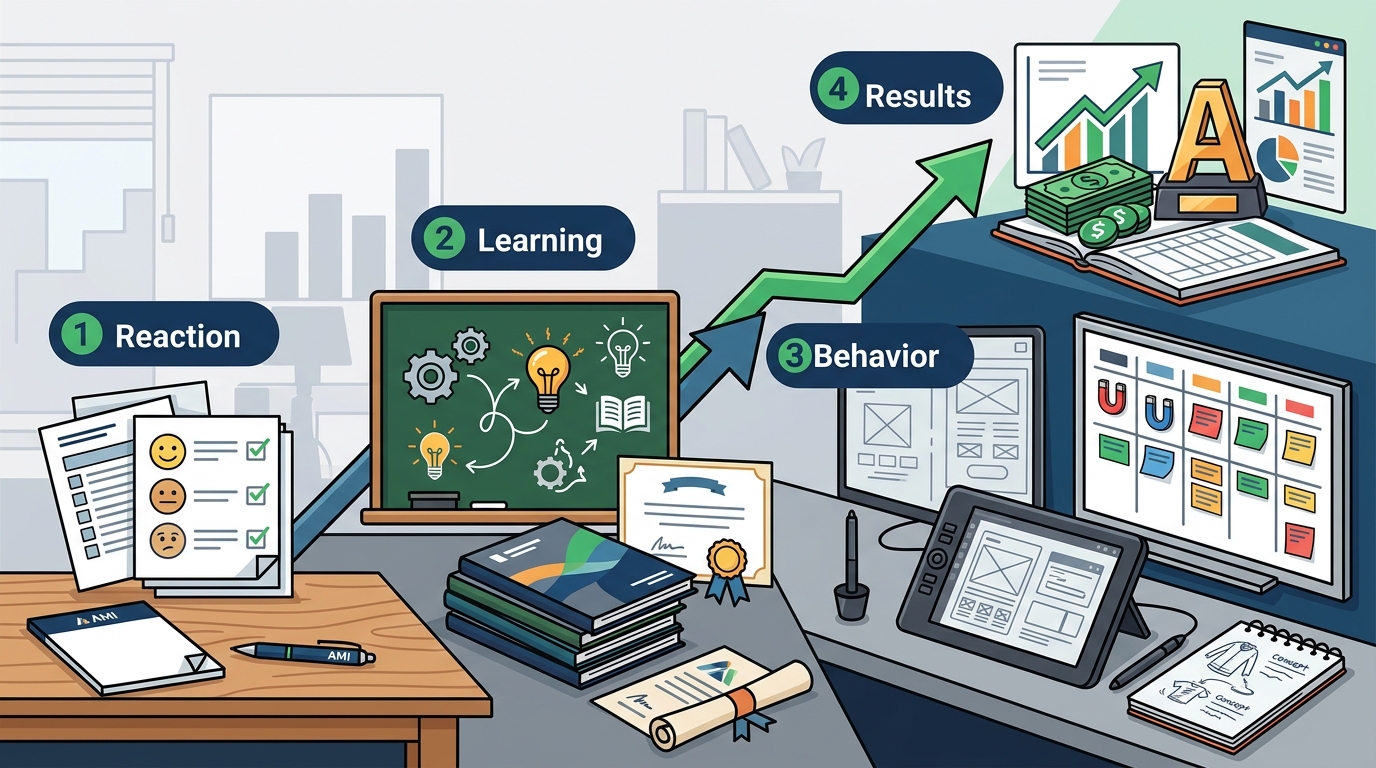
The Kirkpatrick Model is a four-level framework for evaluating training effectiveness, ranging from immediate reactions to long-term organizational impact. For small to mid-sized advertising and marketing agencies, it provides a structured way to determine if workshops and peer networks actually drive business growth. Agency Management Institute (AMI) uses these principles to ensure its programs deliver measurable value to agency owners and employees.
Level 1: Reaction and Engagement
The first level of the Kirkpatrick Model is Reaction, which measures how participants feel about the training experience. In the agency context, this is often the easiest metric to capture but the least predictive of long-term success. If an agency owner finds a workshop on sales strategy boring or irrelevant, they are unlikely to implement the new tactics. AMI focuses on high-engagement formats, such as live peer groups and interactive workshops, to ensure that the initial reaction is positive. A positive reaction is a prerequisite for learning, but it is not a guarantee of results.
Level 2: Learning and Knowledge Acquisition
The second level is Learning, which assesses the extent to which participants acquire the intended knowledge, skills, or attitudes. For an agency employee attending an Account Executive bootcamp, this might involve a pre- and post-test on negotiation techniques. However, in the fast-paced world of marketing, knowledge alone is insufficient. An agency might know the theory of client retention but fail to apply it during a difficult account review. AMI’s training programs are designed to bridge the gap between knowing and doing, ensuring that the knowledge gained is practical and immediately applicable to daily agency operations.
Level 3: Behavior and Application
Level 4: Results and Business Impact
The fourth and final level is Results, which measures the extent to which the training produces tangible outcomes in the organization. For agencies, this translates to metrics like increased Agency Gross Income (AGI), higher profit margins, or improved client retention rates. This is the ultimate goal of any training investment. AMI’s mission is to help agencies grow and increase their AGI and profitability, which aligns directly with Level 4 evaluation. By focusing on business outcomes, agencies can justify the cost of training and demonstrate its value to stakeholders. This level requires a baseline measurement before the training and a follow-up measurement after a reasonable period of time.
Practical Application for Agency Owners
Applying the Kirkpatrick Model in a small agency requires a pragmatic approach. Owners often lack the time to conduct rigorous evaluations for every workshop. A practical strategy is to focus on Levels 3 and 4, where the business impact is most significant. For example, after attending a workshop on growing existing clients, an owner might track the number of upsell opportunities identified in the following quarter. This direct link between training and revenue makes the case for continued investment in professional development. AMI’s resources, including its research series and salary surveys, provide the data needed to set realistic benchmarks for these outcomes.
Key Takeaways
- The Kirkpatrick Model consists of four levels: Reaction, Learning, Behavior, and Results.
- Reaction and Learning are easy to measure but do not guarantee business impact.
- Behavior change is the critical bridge between training and profitability.
- Results should be tied to specific agency metrics like AGI and profit margins.
- Agency Management Institute aligns its programs with these evaluation levels to ensure value.
Frequently Asked Questions
What is the Kirkpatrick Model?
The Kirkpatrick Model is a four-level framework for evaluating training effectiveness, ranging from immediate reactions to long-term organizational impact.
Does the Kirkpatrick Model work for small agencies?
Yes, but small agencies should focus on Levels 3 and 4 (Behavior and Results) to ensure the training drives tangible business growth and profitability.
How does AMI use the Kirkpatrick Model?
AMI designs its workshops and peer networks to support behavior change and business results, ensuring that agency owners see measurable improvements in AGI and profitability.
What is the difference between Learning and Behavior?
Learning measures knowledge acquisition, while Behavior measures the application of that knowledge in real-world job tasks.
Why is Level 4 important for agency owners?
Level 4 measures business impact, such as increased revenue or profit, which justifies the investment in training and demonstrates its value.