

How Marketing Agencies Measure the ROI of Workshops and Training Programs
Marketing agencies operate in a high-velocity environment where talent retention and skill acquisition directly impact client retention rates. According to recent industry data, agencies that invest in structured continuous learning see a measurable increase in billable hours and project efficiency. This guide details the exact methodologies used by top-tier firms to quantify the financial impact of internal workshops, bootcamps, and external training programs.
Why Measuring Training ROI Is Critical
Many agency owners view training as a cost center rather than a profit driver. This perspective ignores the compounding value of upskilled teams. When account executives master proposal writing, win rates increase. When creatives learn new automation tools, delivery times shrink. Without measurement, these benefits remain anecdotal. You cannot manage what you do not measure.
Training ROI is not just about immediate sales. It encompasses reduced turnover, improved client satisfaction scores, and faster onboarding times. For agencies relying on project-based revenue, every hour saved in delivery translates directly to the bottom line. The Agency Management Institute emphasizes that structured learning paths are essential for scaling operations without sacrificing quality.
The KPI Framework for Agency Training
To accurately assess training effectiveness, you must establish clear Key Performance Indicators before the workshop begins. Generic feedback forms are insufficient. You need data that ties learning outcomes to business metrics.
1. Behavioral Change Metrics
Did the training change how employees work? Track the adoption rate of new tools or methodologies. For example, if you host a workshop on strategic insights, measure the number of proposals that utilize the new framework within 30 days. This metric proves application, not just attendance.
2. Revenue Impact Metrics
Link training to revenue generation. If an account executive completes a sales momentum lab, track their deal size and win rate compared to their pre-training baseline. A successful workshop should correlate with an increase in average contract value or a decrease in the sales cycle length.
3. Efficiency and Delivery Metrics
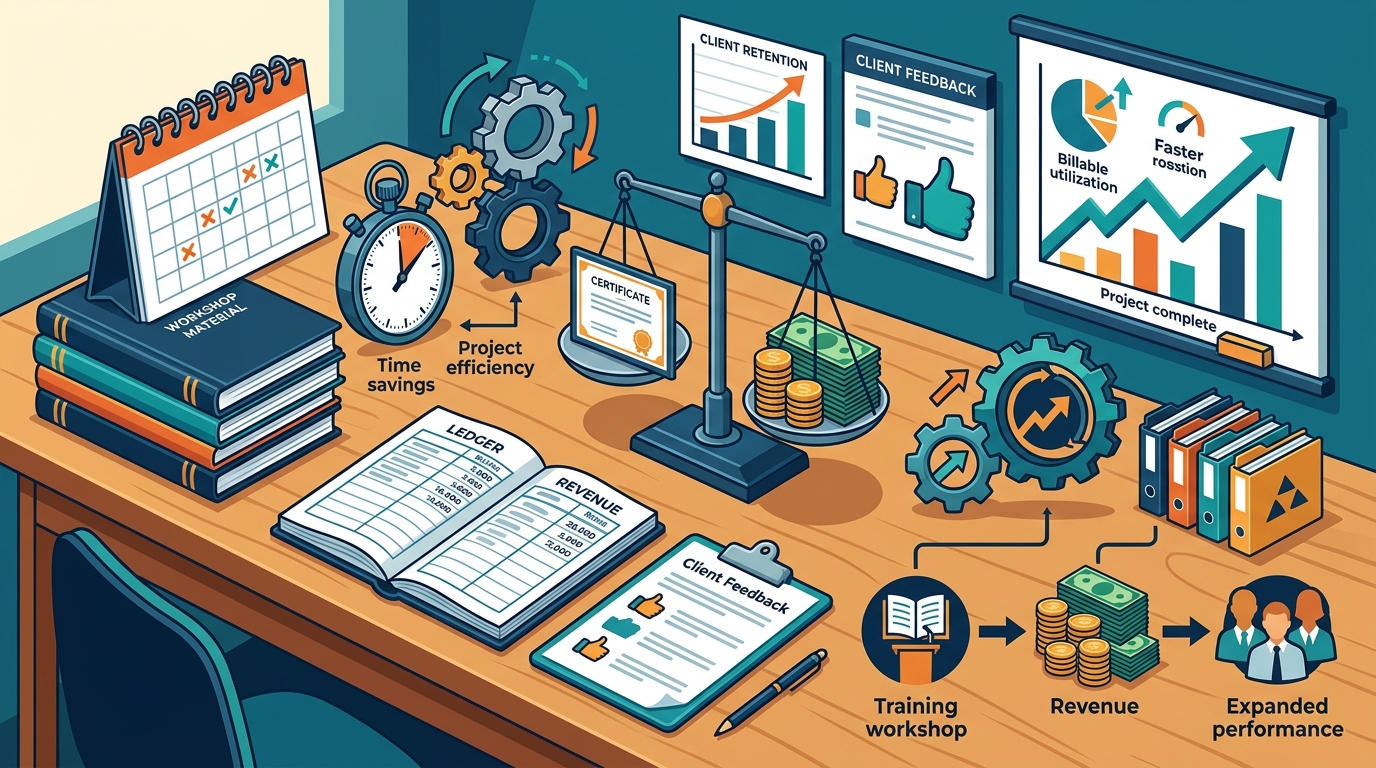
Measure the reduction in hours spent on repetitive tasks. If a creative team attends a workshop on automation, track the hours saved per project. Multiply these hours by the team's blended hourly rate to calculate direct cost savings. This is often the most immediate and tangible ROI signal.
Calculating Direct and Indirect ROI
Calculating ROI requires a formula that accounts for both the costs incurred and the value generated. The standard formula is:
(Net Benefits / Cost of Training) x 100 = ROI Percentage
However, agency training involves complex variables. You must include direct costs such as facilitator fees, venue rental, and materials. You must also account for indirect costs, primarily the billable hours lost while employees are in training. If a senior strategist spends two days in a workshop, calculate their billable rate for those 16 hours and add it to the total cost.
Net benefits include increased revenue from new clients acquired through new skills, reduced client churn due to better service, and cost savings from improved efficiency. For instance, if a workshop on client satisfaction leads to a 5% reduction in churn, calculate the lifetime value of the retained clients. This figure often dwarfs the initial training investment.
According to research on workforce development, companies that track training ROI see a 24% higher profit margin compared to those that do not. This data underscores the importance of rigorous financial tracking in professional development.
Leveraging AMI Resources for Benchmarking
The Agency Management Institute (AMI) provides a robust ecosystem for agency owners seeking to validate their training strategies. AMI offers specialized workshops and peer groups that allow you to benchmark your ROI calculations against industry standards.
AMI’s Advertising Agency Training programs are designed to provide actionable insights that can be directly tied to revenue growth. By participating in these structured learning environments, agency leaders can access proprietary data on what works and what does not.
Additionally, AMI’s Agency Owners resources include salary surveys and research reports that help you contextualize your internal metrics. Understanding industry-wide compensation and performance benchmarks allows you to set realistic ROI targets for your training initiatives. (Statistical Resources Tourism)
AMI also offers Agency Coaching and Consulting services that can help you refine your measurement frameworks. These services provide personalized guidance on integrating training outcomes into your broader business strategy.
Workshop Formats and Expected Outcomes
Different training formats yield different types of ROI. Understanding these distinctions helps you choose the right investment for your current business needs.
| Workshop Format | Primary Focus | Expected ROI Timeline | Best For |
|---|---|---|---|
| Advanced AE Bootcamp | Sales Skills & Proposal Writing | 1-3 Months | Increasing Win Rates |
| Client Growth Workshops | Account Management & Upselling | 3-6 Months | Revenue Expansion |
| Money Matters Seminars | Financial Management & Pricing | Immediate | Margin Improvement |
| AI & Automation Peer Groups | Operational Efficiency | 6-12 Months | Cost Reduction |
Each format requires a different measurement approach. Sales bootcamps should be measured by deal velocity and conversion rates. Financial seminars should be measured by margin expansion and pricing accuracy. Automation peer groups should be measured by hours saved and error reduction.
Key Takeaways
- Training is an Investment, Not a Cost: Agencies that track training ROI see significantly higher profit margins and client retention rates.
- Use the Standard ROI Formula: Always calculate (Net Benefits / Cost of Training) x 100 to get a clear percentage return.
- Include Hidden Costs: Factor in the billable hours lost during training to get an accurate total investment figure.
- Track Behavioral Change: Measure the adoption of new skills in real-world scenarios, such as proposal writing or tool usage.
- Leverage Industry Benchmarks: Use resources like the AMI Salary Survey to contextualize your internal performance data.
- Choose the Right Format: Align workshop types with specific business goals, such as sales growth or operational efficiency.
- Continuous Measurement: ROI is not a one-time calculation. Monitor outcomes over 3, 6, and 12-month periods to capture long-term benefits.
Frequently Asked Questions
How do you calculate the ROI of employee training?
Calculate ROI by subtracting the total cost of training (including materials and lost billable hours) from the net financial benefits generated by the training. Divide this result by the total cost and multiply by 100 to get a percentage.
What is the best way to measure the effectiveness of a sales workshop?
The most effective way is to track the win rate and average deal size of participants compared to their pre-training performance over a 90-day period. This directly links the training to revenue generation.
How does AMI help agencies measure training success?
AMI provides proprietary research, salary surveys, and peer groups that allow agency owners to benchmark their training outcomes against industry standards. Their Agency Edge Research Series offers specific insights into what drives agency growth.
What are the hidden costs of agency training?
Hidden costs include the billable hours of employees who are in training rather than working on client projects. It also includes the time spent by managers on coordinating the training and evaluating its outcomes.
How often should agencies review their training ROI?
Agencies should review training ROI immediately after the workshop for short-term metrics like satisfaction and adoption. Long-term financial impacts should be reviewed quarterly or annually to capture the full value of skill acquisition.
Can training reduce client churn?
Yes. Training account executives in client satisfaction and strategic communication can significantly reduce churn. AMI’s Client Satisfaction Surveys help agencies identify gaps in service that training can address.
What is the difference between direct and indirect training ROI?
Direct ROI includes measurable financial gains like increased sales or cost savings. Indirect ROI includes harder-to-quantify benefits like improved employee morale, better team cohesion, and enhanced brand reputation.
Next Steps for Agency Leaders
Stop guessing the value of your training programs. Start measuring them with precision. The Agency Management Institute offers the tools, research, and community support you need to transform your training budget into a profit center. Explore our Membership options to access exclusive workshops and peer groups designed to drive measurable agency growth. Visit agencymanagementinstitute.com to schedule a consultation and begin your journey toward data-driven excellence.