

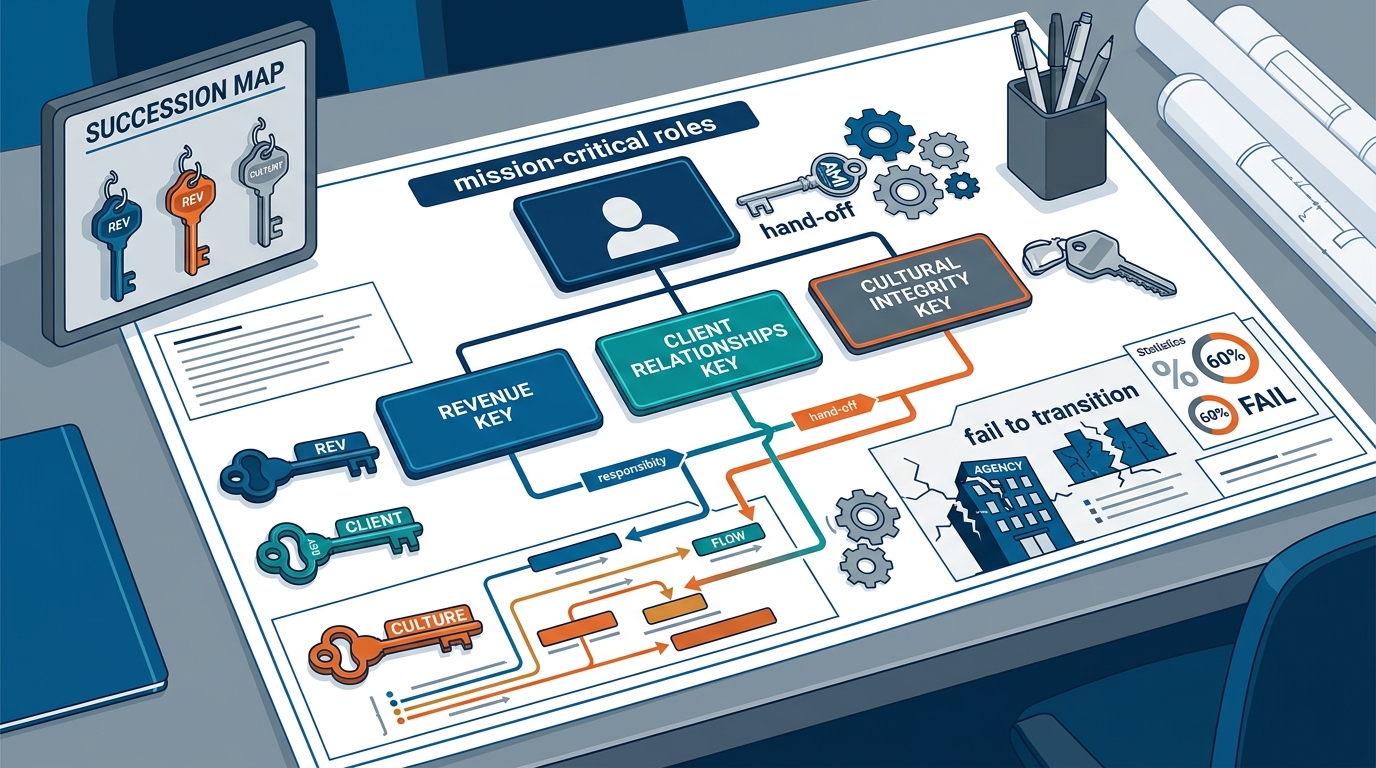
Succession planning is often the most neglected aspect of agency growth, yet it is the single biggest determinant of long-term survival. According to recent industry research, over 60% of small to mid-sized agencies fail to transition leadership effectively within five years of the founder's exit. This statistic highlights a critical gap in operational readiness. Without a clear map of who holds the keys to revenue, client relationships, and cultural integrity, an agency risks collapse the moment its primary driver steps away. Identifying mission-critical positions is not just an HR exercise. It is a strategic imperative for preserving enterprise value.
Defining Mission-Critical Positions
Before you can plan for succession, you must define what makes a role "mission-critical." In the context of an advertising, marketing, or PR agency, this definition goes beyond job title. It focuses on irreplaceability. A mission-critical position is one where the loss of the incumbent would cause immediate, severe disruption to revenue streams, client retention, or operational continuity.
Succession readiness is not about replacing people. It is about de-risking the business. When you identify these roles, you are essentially auditing the agency's vulnerability. If only one person knows how to negotiate the primary media buy, or if only one account executive holds the trust of your top three clients, those positions are mission-critical. The Agency Management Institute emphasizes that comprehensive succession planning requires a proactive audit of these specific dependencies rather than a reactive response to a crisis.
The Revenue Architects
The first layer of mission-critical roles involves those who directly drive new business. In many agencies, the founder or a senior partner is the primary rainmaker. While this is a common starting point, it is a dangerous dependency.
The Chief Revenue Officer or VP of Sales
This role is responsible for the strategic direction of sales, not just closing deals. If the VP of Sales leaves, do they take the pipeline with them? The mission-critical nature of this role lies in their ability to articulate the agency's value proposition to prospective clients. Succession here requires a candidate who understands not just sales tactics, but the financial architecture of the agency.
Senior Account Directors
Senior Account Directors often bridge the gap between sales and delivery. They are the first point of contact for high-value prospects. If these roles are vacant or understaffed, the agency's growth engine stalls. Identifying these positions early allows you to implement structured sales training programs that institutionalize knowledge rather than relying on individual charisma.
The Client Keepers
Revenue is generated by sales, but it is preserved by client management. The second layer of mission-critical roles involves those who maintain the relationships that keep the lights on.
Key Account Managers
These individuals are the daily interface between the agency and the client. Their mission-critical status is defined by the depth of their relationship. If a client only trusts one person, that person is a single point of failure. To mitigate this, agencies must implement client satisfaction surveys and multi-touchpoint communication strategies that distribute relationship equity across the team.
Strategic Planners
In advertising and PR, strategic planners are the architects of the work. They translate client goals into actionable campaigns. If a lead planner departs, the continuity of the creative strategy is at risk. Succession planning for these roles involves documenting the "why" behind every strategic decision, ensuring that the institutional knowledge remains within the agency, not in the planner's head.
The Operational Nerve Center
While revenue and client roles are visible, the operational backbone is often overlooked until it breaks. These roles ensure that the agency delivers on its promises efficiently and profitably.
The COO or Operations Director
The COO is responsible for the internal machinery of the agency. This includes resource allocation, budget management, and process optimization. If the COO leaves without a successor, operational chaos ensues. Projects miss deadlines, budgets are blown, and employee morale drops. The Virtual COO Peer Group provides a forum for these leaders to share best practices, highlighting the complexity of the role and the need for robust succession pipelines.
Finance and Administration Leads
These roles manage cash flow, payroll, and compliance. While they may not be client-facing, their absence can halt the agency's ability to operate. Succession here requires a deep understanding of agency-specific financial metrics, such as utilization rates and project profitability.
Cultural Anchors and Talent Retention
Agencies are people businesses. The culture is the glue that holds the team together. Mission-critical roles in this category are those that influence employee engagement and retention.
HR and People Operations
In a competitive talent market, the HR leader is critical for attracting and retaining top talent. They are responsible for the employee experience, from onboarding to offboarding. If this role is vacant, the agency risks a talent exodus. Succession planning for HR involves ensuring that the next leader is not just an administrator, but a strategic partner in business growth.
Department Heads
Heads of Creative, Media, and Digital are the leaders of their respective domains. They are responsible for the quality of work and the development of junior staff. Their departure can lead to a loss of creative direction and a drop in service quality. Identifying these roles as mission-critical allows the agency to invest in leadership development programs that prepare the next generation of department heads.
Building the Succession Matrix
Once you have identified the mission-critical roles, the next step is to build a succession matrix. This tool maps each critical role to potential successors, assessing their readiness and development needs.
| Mission-Critical Role | Key Dependencies | Succession Risk Level | Recommended Action |
|---|---|---|---|
| Founder/CEO | Vision, Key Client Relationships, Final Decision Making | Critical | Engage in exit planning workshops |
| VP of Sales | Pipeline Management, Sales Strategy, Team Leadership | High | Implement sales process standardization |
| Lead Account Director | Client Trust, Strategic Insight, Project Oversight | High | Distribute client touchpoints and document strategies |
| COO | Operational Continuity, Budget Control, Process Efficiency | Medium | Cross-train senior managers on operational metrics |
| Head of Creative | Creative Vision, Talent Retention, Quality Control | Medium | Develop internal mentorship programs for senior creatives |
This matrix serves as a living document. It should be reviewed quarterly to assess the readiness of successors and the evolving needs of the agency. By visualizing these dependencies, agency owners can prioritize their development efforts and allocate resources effectively.
Frequently Asked Questions
What is the first step in identifying mission-critical roles?
The first step is to conduct a comprehensive audit of the agency's operations. This involves mapping out every role, its dependencies, and the impact of its absence. The Agency Edge Research Series provides valuable insights into common pitfalls and best practices for this audit.
How do I distinguish between a key role and a mission-critical role?
A key role is important, but a mission-critical role is irreplaceable in the short term. If the role is vacant for more than two weeks, does the agency suffer significant revenue loss or operational failure? If yes, it is mission-critical.
What if there are no internal candidates for a mission-critical role?
In such cases, the agency must invest in external recruitment or consider interim solutions. However, the long-term goal should always be to develop internal talent. The Agency Advantage membership offers resources for building internal leadership pipelines.
How often should succession plans be updated?
Succession plans should be reviewed at least annually, or whenever there is a significant change in the agency's structure, strategy, or leadership team. Regular updates ensure that the plan remains relevant and actionable.
Can a founder be both a mission-critical role and a successor?
Yes, but this creates a paradox. If the founder is the only successor, the risk remains high. The goal is to transition the founder from being the sole incumbent to being a mentor or advisor, thereby reducing their direct dependency.
What role does technology play in succession planning?
Technology can help document processes, store client information, and track performance metrics. By leveraging AI and automation tools, agencies can reduce the reliance on individual knowledge and make institutional knowledge more accessible.
How do I handle the emotional aspect of succession planning?
Succession planning can be emotionally charged for founders and leaders. It is important to approach the process with transparency and empathy. The Leadership Coaching services offered by AMI can provide support for leaders navigating these complex transitions.
Next Steps for Your Agency
Identifying mission-critical positions is just the beginning. The true value lies in the actions you take to mitigate the risks associated with these roles. Whether you are looking to engage in agency consulting, join a peer group, or access our latest research, the Agency Management Institute is here to support your journey.
Do not wait for a crisis to force your hand. Start your succession planning process today. Visit our 2026 Webinars page to register for upcoming sessions on leadership and growth, or explore our membership options to connect with a community of agency owners dedicated to sustainable success.