

If you own a small to mid-sized advertising or marketing agency, succession planning is one of the most consequential decisions you will ever make. Yet most agency owners avoid it. According to a Deloitte survey, 86% of leaders believe succession planning is an urgent priority, but only 14% feel confident in their plans. The good news: you do not need to figure this out alone. This guide walks you through every phase of implementing comprehensive succession planning so your agency thrives long after you step back.
What Is Agency Succession Planning?
Succession planning is the deliberate process of identifying and developing internal talent to fill key leadership positions as they become available. For agency owners specifically, it means preparing your business to run without you, whether you plan to sell, transfer ownership to a family member, or promote an internal leader.
Unlike simple replacement hiring, comprehensive succession planning addresses every critical role in the organization. It connects leadership development, financial strategy, and cultural continuity into one cohesive roadmap. As the Corporate Finance Institute notes, the process ensures there is no leadership vacuum after the retirement or exit of a senior officer.
Why You Should Start at Least a Decade Early
This is not hyperbole. AMI founder Drew McLellan, who works with hundreds of agency owners every year, is clear on the timeline: if you want control over your exit strategy, you should have a solid idea of how you want it to play out at least ten years before you are ready to step away.
Why so long? Every major decision you make today, from staffing to positioning to profitability targets, either moves your agency toward or away from a successful transition. Starting early gives you time to course-correct, develop leaders, and maximize the value of your life's work.
The Cost of Waiting
According to Harvard Business Review, poorly managed CEO transitions wipe out nearly $1 trillion in market value each year among S&P 1500 companies. Smaller agencies face proportionally similar risks when a founder departs without a plan: client attrition, employee turnover, and a fire-sale valuation.
Common Succession Options for Agency Owners
Before you build a plan, you need to know the paths available. Here is a comparison of the most common succession routes for agency owners.
| Succession Path | Best For | Timeline | Key Consideration |
|---|---|---|---|
| Internal sale to employee(s) | Owners with strong second-tier leadership | 5-10 years | Requires leadership coaching and financing structure |
| Family succession | Owners with interested, capable family members | 5-15 years | Must separate family dynamics from business decisions |
| External sale or merger | Owners seeking maximum financial return | 3-5 years | Buyer cultural fit is critical to post-sale success |
| Private equity acquisition | Agencies with strong recurring revenue | 2-5 years | Often requires owner to stay on for a transition period |
| Gradual ownership transfer | Owners wanting to reduce involvement over time | 5-10 years | Minority ownership stakes create incentive alignment |
Each path demands a different set of preparations. AMI's Comprehensive Succession Planning Program helps you evaluate which option aligns with your personal goals, your team's capabilities, and your agency's market position.
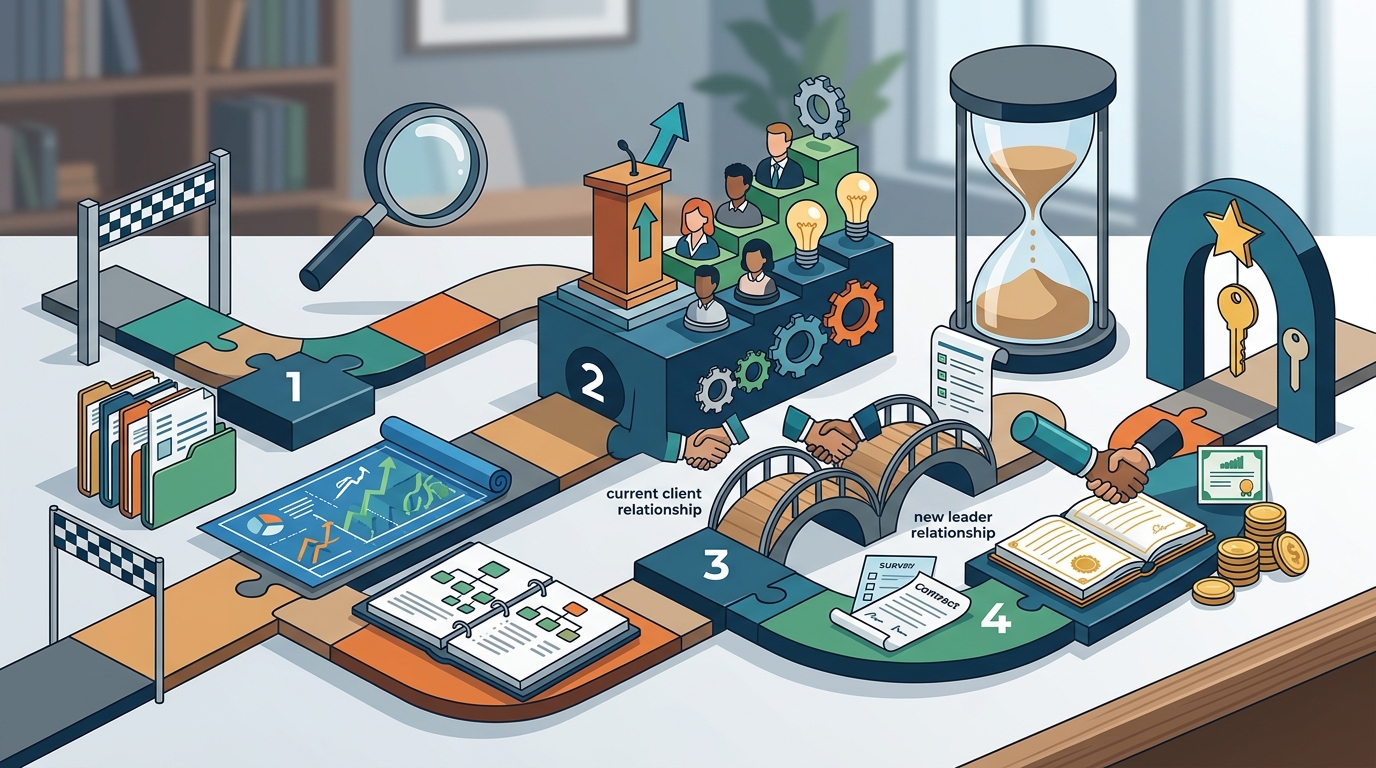
Step-by-Step Implementation Framework
1. Define Your Personal Exit Vision
Start with the end in mind. Do you want to walk away completely, stay on as an advisor, or reduce your role gradually? Your answer shapes every subsequent decision. Be honest about your timeline and financial needs.
2. Identify Critical Roles and Potential Successors
Map every position that, if vacated suddenly, would disrupt operations. Then assess which employees have the potential to step up. Use structured assessments, not gut feelings, to evaluate leadership readiness. AMI runs employees through agency-specific assessments that measure behaviors, motivations, and competencies.
3. Build a Financial and Legal Foundation
Work with your accountant and attorney to establish a valuation methodology, draft buy-sell agreements, and explore financing options. Most internal deals use the agency's cash flow to fund the transition over multiple years, so profitability today directly affects your payout tomorrow.
Developing Your Future Leaders
A leadership pipeline is the engine of any succession plan. A leadership pipeline is a structured system for identifying, training, and advancing employees into progressively senior roles. Without it, you are gambling that the right person will be ready at exactly the right moment.
Effective development includes mentorship, stretch assignments, cross-functional exposure, and formal coaching. AMI's leadership coaching program pairs potential successors with experienced facilitators who help them build the soft skills required to lead, not just manage.
Peer learning accelerates this process. When future leaders connect with counterparts at other agencies, they gain perspective that internal training alone cannot provide. AMI's peer network memberships offer exactly this kind of collaborative environment for both owners and key leaders.
Getting an Accurate Agency Valuation
An agency valuation is a formal assessment of what your business is worth based on profitability, growth trajectory, client retention, and revenue diversity. Getting this number right is foundational whether you are planning an internal transfer or an external sale.
Owners who skip this step often discover, too late, that they priced their agency based on emotion rather than data. Profitability, documented processes, and strong client relationships do not just make your agency more transferable. They make it more successful right now.
Revisit your valuation annually. Market conditions shift, and so does your agency's value. Connecting with other owners through an AMI owner peer network gives you access to real financial benchmarking data from agencies of similar size.
Key Takeaways
- Start succession planning at least 10 years before your intended exit to maximize your options.
- Succession planning is not just about retirement. It is a business continuity strategy that strengthens your agency today.
- Identify all critical roles, not only the owner position, and map potential successors for each.
- Invest in leadership development through coaching, assessments, and peer learning.
- Get a professional valuation and revisit it annually.
- Choose a succession path that aligns your personal goals, team readiness, and market conditions.
- Do not go it alone. Work with experienced advisors who specialize in agency transitions.
Frequently Asked Questions
How long does agency succession planning take?
A comprehensive succession plan typically takes 5 to 10 years to fully implement. The earlier you start, the more flexibility and control you retain over the outcome.
What if I do not have an obvious successor inside my agency?
That is common. Begin by investing in leadership coaching for your strongest employees. AMI's coaching programs use agency-specific assessments to determine whether a team member can level up to an ownership or senior leadership role.
How much is my agency worth?
Valuation depends on profitability, client retention, revenue diversity, and growth trajectory. Hire a professional who understands the agency business model to get an accurate number.
Can I sell part of my agency and keep the rest?
Yes. Many owners sell a majority stake, such as 80%, and roll the remaining equity into the new structure. This lets you participate in future upside while reducing your day-to-day responsibility.
What is the biggest mistake agency owners make with succession planning?
Waiting too long. Every year of delay narrows your options and can reduce your agency's value at transition time.
Should I tell my employees about the succession plan?
Transparency builds trust. You do not need to share every detail, but communicating a high-level continuity plan projects stability and reduces anxiety among staff and clients.
How do peer networks help with succession planning?
Peer networks connect you with other agency owners who have navigated the same challenges. They offer financial benchmarking, candid advice, and proven strategies you will not find in a textbook.
Start Building Your Succession Plan Today
The best time to begin succession planning is when it feels premature. Do not wait until you are burned out or ready to retire to start thinking about what comes next. Explore AMI's Comprehensive Succession Planning Program to get expert guidance tailored to your agency's size, structure, and goals. Your future self will thank you.