

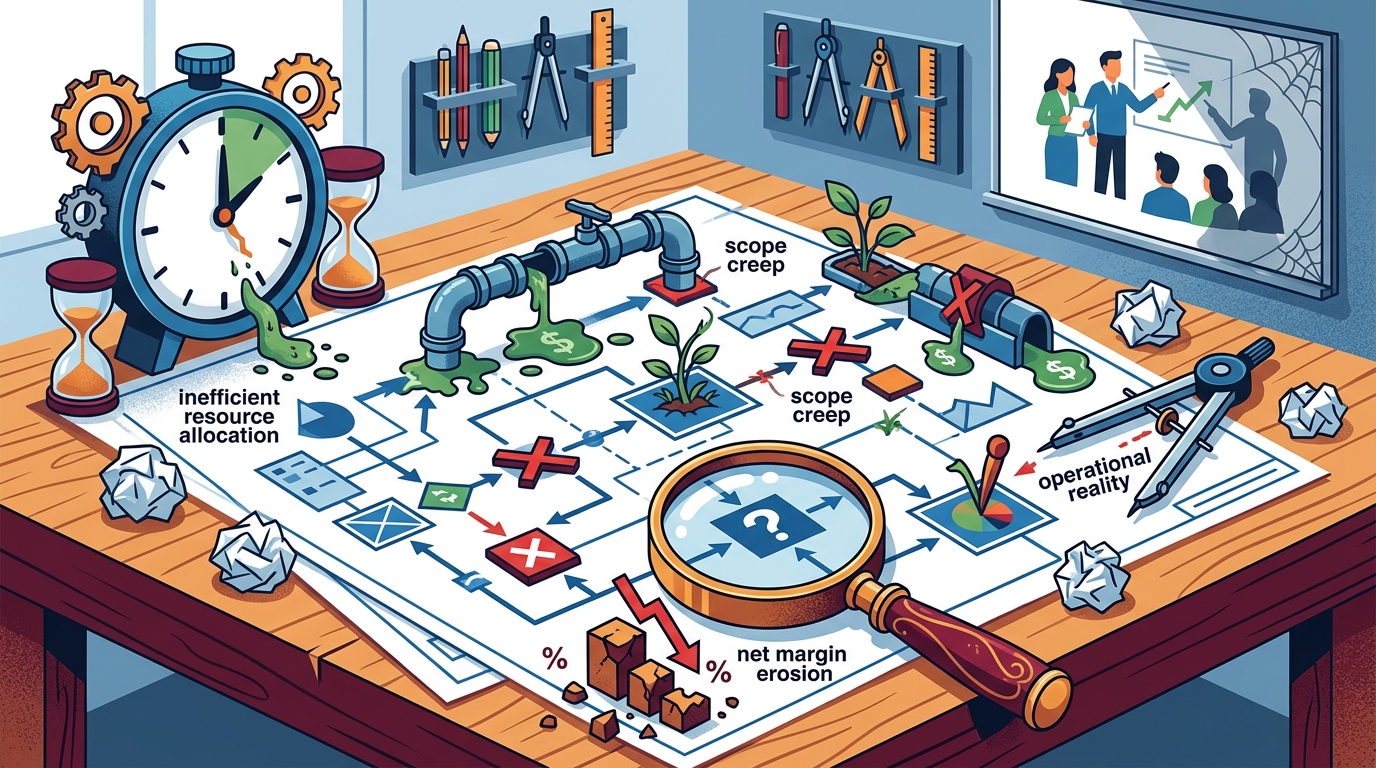
Agency profitability is not a static metric but a dynamic outcome of disciplined operational habits. According to recent industry benchmarks, agencies that fail to implement structured financial oversight often see their net margins erode by 15 to 20 percent within a single fiscal year due to unchecked scope creep and inefficient resource allocation. This decline is rarely caused by a lack of creative talent or sales volume. Instead, it stems from a fundamental misunderstanding of how workshop-based learning translates into daily operational reality. Many agency leaders attend training sessions with high hopes, only to return to their desks with a notebook full of ideas but no executable framework. The gap between theoretical knowledge and practical application is where most profitability strategies fail. This guide outlines the most common pitfalls encountered during agency profitability workshops and provides concrete strategies to ensure your investment yields measurable returns.
Pitfall 1: The "One-Size-Fits-All" Curriculum Trap
One of the most frequent errors agency owners make is selecting a workshop based solely on the instructor's reputation rather than the specific maturity stage of their business. A workshop designed for a scaling agency with 50 employees will likely fail a boutique firm with five staff members. The operational complexities, cash flow cycles, and client acquisition costs differ drastically between these two models. When the curriculum does not match your current scale, the advice becomes abstract and difficult to implement. You may find yourself trying to apply enterprise-level financial controls to a small team that relies on agility and personal relationships. This mismatch leads to frustration and a sense that the training was irrelevant to your daily challenges.
To avoid this, you must first conduct a rigorous internal audit of your agency's current phase. Are you in the survival phase, the growth phase, or the optimization phase? Each phase requires a different profitability focus. For instance, survival-focused agencies need immediate cash flow management techniques, while growth-focused firms need scalable sales processes. AMI provides specialized resources tailored to these distinct stages, ensuring that the training you receive is directly applicable to your immediate operational needs. Always ask potential workshop providers about the specific agency profiles they typically serve. If their primary audience is vastly different from yours, the curriculum will likely miss the mark.
Pitfall 2: Ignoring the Human Element of Change
Profitability is not just a numbers game; it is a behavioral challenge. Workshops often focus heavily on financial metrics, pricing models, and efficiency hacks. However, they frequently neglect the psychological resistance that comes with changing long-standing habits. When you introduce new profitability frameworks, your team may perceive them as threats to their autonomy or job security. This resistance can manifest as passive non-compliance, where staff continue to work in old ways despite knowing the new methods. If you do not address the human side of this transition, your new processes will collapse under the weight of organizational inertia.
The solution lies in integrating change management principles into your workshop learning. Treat the workshop not as a one-time event but as the beginning of a cultural shift. Communicate the "why" behind every new profitability metric to your team. Show them how increased agency profitability leads to better job stability, more interesting projects, and potentially higher compensation. Leadership coaching can be instrumental in helping you navigate these conversations. By framing profitability as a tool for empowerment rather than control, you align your team's interests with your financial goals. This alignment is critical for sustaining the momentum generated during the workshop.
Pitfall 3: Lack of Post-Workshop Accountability
The "forgetting curve" is a well-documented psychological phenomenon where information is lost over time unless it is actively reviewed. In the context of agency workshops, this means that without a structured follow-up plan, you will retain only a fraction of the actionable insights within 30 days. Many agency owners experience a burst of enthusiasm immediately after a workshop, only to see their progress stall as daily operational fires take precedence. This lack of accountability is the primary reason why so many training investments yield zero return on investment.
To combat this, you must build a system of accountability that extends beyond the workshop walls. This could involve scheduling monthly review sessions with your leadership team to assess progress against the workshop's key takeaways. You might also consider joining a peer group where you can share challenges and successes with other agency owners. Virtual Agency Owner Peer Groups provide a consistent forum for discussing implementation hurdles and celebrating wins. These groups create a sense of community and obligation that keeps you focused on applying the workshop's lessons. Additionally, assign specific owners to each action item from the workshop. When everyone knows who is responsible for what, execution becomes significantly more likely.
Pitfall 4: Confusing Activity with Profitability
A subtle but dangerous pitfall is mistaking busyness for profitability. Workshops often teach you to optimize processes, increase sales, and improve client retention. However, if you implement these changes without a clear link to the bottom line, you may end up with a more efficient but less profitable agency. For example, you might streamline your project management workflow, reducing the time spent on administrative tasks. While this is a positive outcome, it does not automatically increase profit unless you either bill for that time or use the freed-up capacity to take on higher-margin work.
Profitability is defined as the ability to generate net income after all expenses are accounted for. You must ensure that every new process or strategy introduced in the workshop has a direct or indirect impact on your net margin. Use a profitability matrix to evaluate each initiative. Does it reduce costs? Does it increase revenue? Does it improve client lifetime value? If the answer is no to all three, it may be a distraction rather than a solution. Money Matters workshops specifically address these financial nuances, helping you distinguish between vanity metrics and true profitability drivers. Focus on the metrics that matter, such as profit per employee and client acquisition cost, rather than just top-line revenue.
Pitfall 5: Neglecting the Leadership Team
Another common error is focusing the workshop's lessons solely on the agency owner. Profitability is a team sport. If only the owner understands the new financial frameworks and operational standards, the rest of the leadership team will continue to operate in silos. This disconnect creates friction and inefficiency. For instance, if the sales team is incentivized to close deals at any cost, they may sell services that are difficult to deliver, leading to scope creep and margin erosion. The delivery team, unaware of the profitability implications, will struggle to meet expectations.
To avoid this, ensure that your key leaders attend the workshop with you or participate in a dedicated debriefing session. They need to understand the strategic rationale behind the new profitability measures. Provide them with the same tools and resources you received. Growing your leadership team workshops are designed to align your executive group around common goals and metrics. When your leadership team is unified in their understanding of profitability, they can enforce standards consistently and support each other in implementation. This collective ownership is essential for long-term success.
Comparing Workshop Approaches for Agency Profitability
Not all training methods are created equal. Understanding the differences between various workshop formats can help you choose the right one for your needs. The table below summarizes the key characteristics of common workshop types.
| Workshop Type | Primary Focus | Best For | Implementation Speed |
|---|---|---|---|
| AE Bootcamp | Sales techniques and proposal writing | Agencies needing immediate revenue growth | Fast |
| Build a Sales Machine | Systematic sales process development | Agencies with inconsistent pipelines | Medium |
| Advanced AE Bootcamp | Strategic account management | Senior sales leaders | Slow |
| Running Your Agency for Growth | Financial health and operational sanity | Owners feeling overwhelmed | Medium |
Key Takeaways
- Mismatched Curricula: Selecting a workshop that does not align with your agency's size and stage leads to ineffective implementation and wasted resources.
- Behavioral Resistance: Ignoring the human element of change can cause your team to resist new profitability frameworks, undermining your efforts.
- Accountability Gaps: Without a structured follow-up plan, the insights gained from workshops are quickly forgotten, resulting in no tangible ROI.
- Activity vs. Profit: Optimizing processes without linking them to net income can create efficiency without profitability, a common trap for growing agencies.
- Leadership Alignment: Profitability requires a unified leadership team. If only the owner understands the goals, execution will be fragmented and inconsistent.
- Peer Support: Joining Virtual AI & Automation Peer Groups or other peer networks provides essential support for sustaining long-term change.
- Strategic Selection: Use AMI's research series to identify the most relevant training for your specific operational challenges.
Frequently Asked Questions
How do I know if a workshop is right for my agency?
Assess your agency's current maturity stage and specific pain points. If you are struggling with cash flow, look for workshops focused on financial management. If sales are inconsistent, prioritize sales process training. Always review the target audience of the workshop to ensure it matches your agency's size and industry.
What is the most common reason workshops fail to deliver results?
The most common reason is the lack of post-workshop accountability. Without a system to track implementation and hold team members responsible, the initial enthusiasm fades, and old habits return. Establishing clear action items and review cycles is essential.
Can small agencies benefit from profitability workshops?
Yes, small agencies can benefit significantly. However, they must choose workshops tailored to their scale. Enterprise-level financial controls may be too complex for a small team. Focus on practical, high-impact changes that improve cash flow and client retention.
How important is leadership team involvement in workshop outcomes?
Critical. Profitability is a team effort. If only the owner attends, the leadership team may not understand the new standards or feel invested in the outcome. Involving key leaders ensures alignment and consistent execution across the agency.
What role does peer support play in maintaining profitability gains?
Peer support provides accountability, shared learning, and emotional support. Live Owner Peer Groups allow you to discuss challenges with others facing similar issues, providing practical solutions and motivation to stay on track.
How often should agency owners attend profitability training?
There is no fixed rule, but regular engagement is key. Many successful owners attend at least one major workshop or webinar per quarter to stay updated on industry trends and refine their strategies. Continuous learning is essential in the dynamic agency landscape.
What is the difference between a workshop and a consulting engagement?
Workshops provide structured learning and frameworks for groups, while consulting offers personalized, one-on-one guidance tailored to your specific situation. Advertising Agency Consulting can complement workshops by addressing unique challenges that general training cannot cover.
Take Action to Secure Your Agency's Future
Avoiding profitability workshop pitfalls requires intentionality, alignment, and accountability. By selecting the right curriculum, engaging your leadership team, and establishing robust follow-up systems, you can transform workshop insights into sustainable financial growth. Do not let another training investment go to waste. Start by auditing your current needs and exploring the 2026 webinars offered by AMI. Schedule a consultation with our team to discuss how we can help you build a more profitable, resilient agency. Visit our contact page to begin your journey toward operational excellence.