

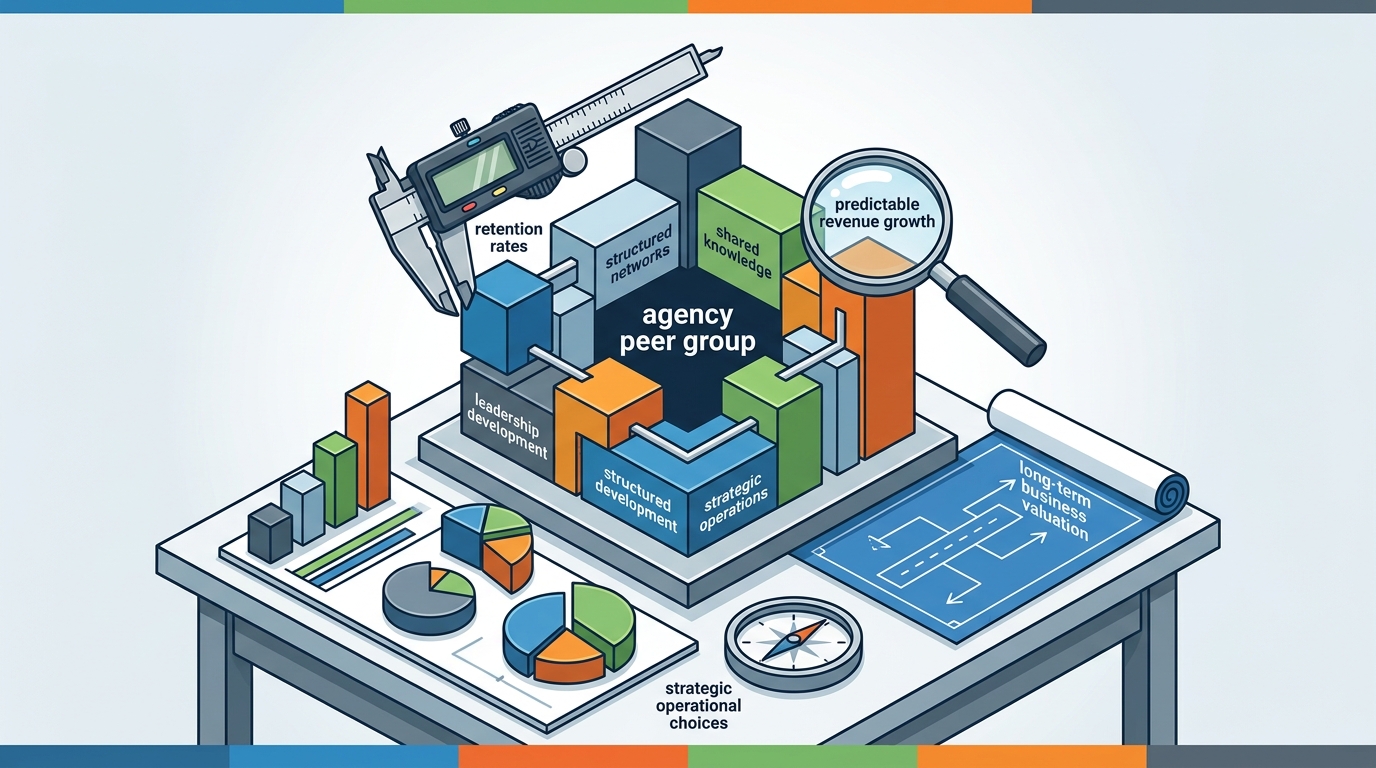
Marketing agency owners face a critical inflection point when considering peer group membership. According to recent industry analysis, agencies that actively participate in structured peer networks report significantly higher retention rates and more predictable revenue growth compared to those operating in isolation. The decision to join a peer group is not merely a networking exercise. It is a strategic operational choice that impacts leadership development, client acquisition, and long-term business valuation. This guide outlines the essential criteria for evaluating these programs to ensure alignment with your agency's specific growth stage and cultural values.
Understanding the Role of Agency Peer Groups
A peer group is a structured community of business owners who meet regularly to share challenges, strategies, and resources. Unlike informal networking events, these groups operate under strict confidentiality agreements and facilitated agendas. The primary value proposition lies in the collective intelligence of the group. Agency owners often suffer from "founder's isolation," where the burden of decision-making rests solely on their shoulders. Peer groups mitigate this by providing a safe harbor for testing ideas and receiving unbiased feedback.
Effective peer groups function as a board of directors without the legal liabilities. They offer accountability mechanisms that drive execution. When evaluating a group, consider whether it serves as a sounding board for strategic pivots or a tactical workshop for immediate operational hurdles. The Agency Management Institute (AMI) has long recognized that structured peer interaction is a cornerstone of sustainable agency growth. Their research indicates that agencies leveraging peer insights often outperform their peers in profitability metrics.
Evaluating Facilitation Quality and Structure
The quality of a peer group is directly tied to the skill of its facilitator. A poor facilitator allows the conversation to drift into complaint sessions or sales pitches. A strong facilitator keeps the group focused on actionable outcomes and ensures equitable participation. Look for facilitators who have deep operational experience in the agency space. They should be able to challenge assumptions and guide members toward self-discovery rather than providing direct answers.
The Importance of Confidentiality
Trust is the currency of peer groups. The structure must enforce strict confidentiality. Members must feel safe discussing financial struggles, client losses, and internal conflicts. If a group lacks clear protocols for maintaining privacy, it will fail to generate high-value insights. Evaluate the group's code of conduct and the history of its members in respecting these boundaries.
Meeting Cadence and Format
Consistency drives results. The best peer groups meet monthly or quarterly with a consistent format. Virtual options have expanded access, allowing for broader geographic diversity. However, the depth of connection often requires face-to-face interaction. Consider whether the group offers hybrid models that balance convenience with relational depth. AMI offers various membership tiers that cater to different meeting frequencies and formats, ensuring flexibility for busy agency leaders.
Assessing Membership Demographics and Fit
Not all peer groups are created equal. The composition of the group determines the relevance of the insights you will receive. A group of SEO agencies may not provide valuable insights for a full-service creative agency. Evaluate the size, revenue range, and service offerings of current members. The ideal group contains a mix of peers who are at similar stages of growth but offer diverse perspectives on execution.
Revenue and Size Alignment
Challenges faced by a $500,000 agency differ significantly from those of a $10 million agency. Ensure the group is segmented by size or revenue to maintain relevance. Cross-segment discussions can lead to misaligned advice. For instance, scaling strategies for a small team do not translate well to managing a large workforce. AMI's Agency Owners resources are tailored to specific business scales, ensuring that the advice remains applicable to your current operational reality.
Geographic and Cultural Fit
While virtual groups have broken down geographic barriers, cultural alignment remains crucial. Do the members share similar values regarding client service, employee treatment, and work-life balance? A group with conflicting core values will create friction rather than collaboration. Look for groups that emphasize cultural fit during the onboarding process. This ensures that all members are committed to the same ethical and professional standards.
Measuring Return on Investment (ROI)
Evaluating the ROI of a peer group requires looking beyond direct financial returns. The value often manifests in avoided mistakes, accelerated decision-making, and enhanced leadership capabilities. Track the number of actionable insights gained per meeting. Assess whether the group has helped you solve critical business problems faster than you could have alone.
Quantifiable Benefits
Look for groups that provide access to proprietary data and benchmarks. AMI's Agency Edge Research Series offers valuable benchmarks that help members compare their performance against industry standards. Access to such data can inform pricing strategies, staffing decisions, and service offerings. The ability to benchmark your agency against a curated peer group is a significant competitive advantage.
Qualitative Benefits
Leadership development is a key qualitative benefit. Peer groups challenge owners to refine their communication, delegation, and strategic thinking skills. The accountability provided by the group often leads to higher personal productivity and clearer vision. Consider the emotional support provided during difficult periods. Knowing that other leaders face similar challenges can reduce stress and improve decision-making clarity.
Comparison Framework for Peer Groups
When comparing different peer group options, use the following framework to assess their suitability for your agency.
| Criteria | High-Quality Peer Group | Low-Quality Peer Group |
|---|---|---|
| Facilitation | Expert-led, structured agendas, accountability focus | Unstructured, dominated by vocal few, no follow-through |
| Membership | Curated, aligned revenue/size, strict confidentiality | Open to all, mixed sizes, loose privacy norms |
| Resources | Proprietary data, workshops, expert speakers | Generic networking, no additional value |
| Commitment | High attendance expectations, active participation | Flexible attendance, passive listening |
| Cost | Reflects value, tiered options, clear ROI | Unclear pricing, hidden fees, low perceived value |
Use this table to score potential groups. A high score in facilitation and membership curation is critical. Resources and commitment levels should align with your agency's capacity and goals. AMI provides 2026 webinars and workshops that complement peer group learning, offering a comprehensive ecosystem for agency growth.
Key Takeaways
- Facilitation is paramount: The quality of the facilitator determines the depth of insight and accountability within the group.
- Demographics matter: Ensure the group's revenue and size alignment matches your agency's current stage to receive relevant advice.
- Confidentiality is non-negotiable: Strict privacy protocols are essential for building the trust required for high-level strategic discussions.
- ROI extends beyond finance: Value includes leadership development, avoided mistakes, and access to proprietary benchmarks.
- Structure drives results: Consistent meeting cadences and clear agendas prevent drift and ensure actionable outcomes.
- Curated membership: Groups that vet their members ensure a higher quality of interaction and shared values.
- Complementary resources: Look for groups that offer additional training, research, and expert access to maximize your investment.
Frequently Asked Questions
What is the primary benefit of joining a marketing agency peer group?
The primary benefit is access to collective intelligence and accountability. Peer groups provide a structured environment for solving complex business challenges, reducing founder isolation, and accelerating growth through shared experiences and benchmarks.
How do I know if a peer group is right for my agency's size?
Evaluate the group's membership criteria. High-quality groups segment members by revenue and employee count to ensure relevance. If your agency's challenges align with the group's focus, it is likely a good fit. AMI offers specialized peer groups tailored to different agency sizes and stages.
Can virtual peer groups be as effective as in-person ones?
Virtual groups can be highly effective if they maintain strict structure and engagement protocols. The key is consistent facilitation and active participation. Many agencies now benefit from the flexibility and broader geographic diversity of virtual peer networks.
What should I look for in a peer group facilitator?
Look for facilitators with deep agency operational experience. They should be able to challenge assumptions, enforce confidentiality, and guide the group toward actionable outcomes without dominating the conversation.
How is the ROI of a peer group measured?
ROI is measured through avoided mistakes, accelerated decision-making, leadership development, and access to proprietary data. Track the number of actionable insights gained and the impact on your agency's performance metrics.
Are there peer groups specifically for small agencies?
Yes, many organizations offer groups tailored to small to mid-sized agencies. These groups focus on scaling challenges, client acquisition, and operational efficiency. Ensure the group's revenue range aligns with your agency's current size.
What is the typical cost of joining a peer group?
Costs vary widely based on the group's prestige, facilitation quality, and additional resources. High-quality groups often charge a premium but provide significant value through benchmarks, training, and networking. AMI offers associate and partner memberships with varying price points to suit different budgets.
Next Steps for Agency Leaders
Evaluating marketing agency peer groups requires a strategic approach. Focus on facilitation quality, membership demographics, and structural integrity. By choosing a group that aligns with your agency's values and growth stage, you can unlock significant operational and leadership benefits. To explore how AMI's peer groups and resources can support your agency's growth, visit our Membership page or contact our team directly to schedule a consultation.