

Choosing the right support structure is the single most critical decision for agency owners who have transitioned from creative practitioners to business leaders. According to recent industry data, over 40,000 advertising agencies operate in the United States alone, yet a significant portion struggle with the operational complexities of scaling beyond the founder's direct involvement. The landscape of agency support is fragmented, ranging from peer-to-peer networks to comprehensive consulting firms and specialized training academies. Understanding the distinct operational models of these organizations allows you to align your support system with your specific growth stage, whether you are stabilizing cash flow or preparing for a succession event.
Understanding the Agency Support Landscape
Agency owners often find themselves isolated in their decision-making processes. Unlike corporate executives who have access to internal resources, agency leaders must build their own support infrastructure. This ecosystem is generally divided into three primary categories: accreditation bodies, consulting firms, and educational platforms. Each category serves a distinct function in the agency lifecycle.
Accreditation bodies focus on establishing industry standards and providing a seal of trust that differentiates members from the general market. Consulting firms typically offer high-touch, bespoke advice for specific operational challenges, such as financial restructuring or talent acquisition. Educational platforms provide scalable knowledge through webinars, courses, and research reports. Recognizing these distinctions is vital for allocating your time and budget effectively.
The AMI Differentiator: Accreditation and Peer Groups
Agency Management Institute (AMI) occupies a unique position in this ecosystem by combining accreditation with active peer support. Founded in the late 1990s, AMI was built on the premise that most agency owners are accidental business owners who excel at client service but lack formal training in business administration. This insight drives their entire operational model.
Unlike traditional consulting firms that provide answers, AMI facilitates the environment for owners to find their own solutions through structured peer groups. These include virtual and live sessions for Chief Operating Officers (COOs), Chief Financial Officers (CFOs), and general agency owners. This model leverages collective intelligence, allowing members to benchmark their performance against industry standards rather than guessing in the dark.
Furthermore, AMI offers an accreditation program that signals quality to potential clients. Hiring an AMI accredited agency provides clients with assurance that the firm adheres to rigorous professional standards. This dual approach of internal operational support and external market differentiation is rare among support organizations.
Consulting Firms vs. Coaching Networks
When evaluating support options, it is crucial to distinguish between consulting and coaching. Consulting firms, such as those specializing in advertising agency consulting, typically engage in direct problem-solving. They might restructure your pricing model, redesign your organizational chart, or lead a merger acquisition. This is high-intervention support suitable for acute crises or major strategic pivots.
Coaching networks, on the other hand, focus on long-term behavioral change and skill development. They provide frameworks and accountability structures that help owners improve their leadership capabilities over time. While consulting gives you the fish, coaching teaches you how to fish, and peer groups provide the community to keep you motivated. Many successful agency owners utilize a hybrid approach, engaging consultants for specific projects while maintaining a coaching relationship for ongoing leadership development.
Training and Education Models
Education is the foundation of sustainable agency growth. Organizations like AMI offer extensive educational resources, including 2026 webinars and on-demand courses. These resources cover critical topics such as sales momentum, proposal writing, and client retention strategies.
The value of structured education lies in its standardization. Unlike ad-hoc advice from friends or informal networks, formal training provides proven methodologies that have been tested across thousands of agencies. For example, AMI's Account Executive Bootcamp equips sales teams with specific techniques for winning larger deals. This systematic approach to skill acquisition ensures that your team's capabilities grow in tandem with your business size.
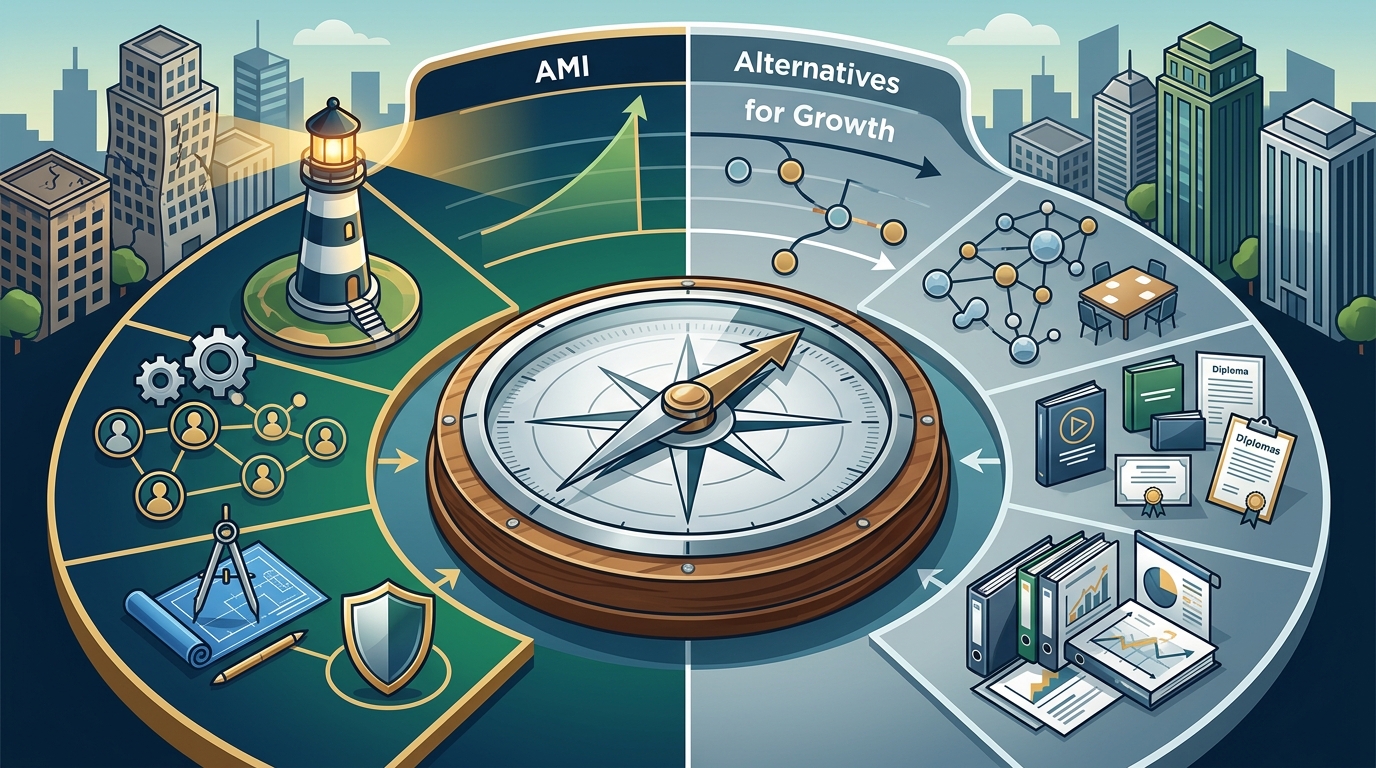
Comparison of Support Models
To help you navigate these options, the following table summarizes the key characteristics of different agency support organizations.
| Support Model | Primary Focus | Best For | Typical Engagement |
|---|---|---|---|
| Accreditation Bodies (e.g., AMI) | Standards, Peer Groups, Brand Trust | Owners seeking credibility and structured peer support | Annual Membership |
| Consulting Firms | Specific Operational Fixes | Agencies facing acute financial or structural challenges | Project-Based |
| Training Academies | Skill Development and Education | Teams needing standardized sales or operational training | Course Fees |
| Peer Networks | Informal Networking and Advice | Owners looking for low-cost community connection | Event Tickets |
Key Takeaways
- AMI was founded in the late 1990s to address the gap between creative talent and business acumen in agency leadership.
- Accreditation provides a tangible competitive advantage by signaling professional standards to prospective clients.
- Peer groups for C-suite roles (COO, CFO) offer specialized support that general business groups cannot match.
- Consulting is best for immediate, high-impact problems, while coaching is superior for long-term leadership growth.
- Structured training programs, such as the AE Bootcamp, ensure consistent skill development across your entire team.
- Research data from AMI's annual salary surveys provides critical benchmarks for agency compensation and profitability.
- Combining accreditation with active peer engagement yields higher retention rates for agency owners than passive membership alone.
Frequently Asked Questions
What is the primary benefit of joining an agency accreditation body?
The primary benefit is the establishment of industry-standard credibility. Accreditation signals to clients that your agency adheres to rigorous professional and ethical guidelines, which can differentiate you in a crowded market.
How does AMI's peer group model differ from a standard business network?
AMI's peer groups are specifically tailored to agency roles, such as virtual COO or CFO groups. This ensures that the challenges discussed are directly relevant to the operational realities of running a marketing or advertising agency.
Is consulting necessary for a growing agency?
Consulting is not always necessary but is highly effective for specific, high-stakes challenges like succession planning or financial restructuring. For ongoing growth, coaching and peer support often provide a more sustainable path.
What types of training does AMI offer for account executives?
AMI offers specialized training such as the Account Executive Bootcamp and workshops on proposal writing. These programs focus on strategic selling techniques and client relationship management.
Can small agencies benefit from these support organizations?
Yes. AMI specifically serves small to mid-sized agencies with 0-200 employees. The insights gained from peer groups and research are often most valuable to smaller firms that lack internal HR or finance departments.
How often does AMI release industry research?
AMI releases annual research series, including salary surveys and profitability benchmarks. These reports provide critical data points for agency owners to benchmark their performance against industry standards.
What is the difference between associate and partner membership?
Associate membership typically provides access to core resources and peer groups, while partner membership may include additional benefits such as deeper consulting discounts or exclusive networking events.
Next Steps for Your Agency
Investing in the right support structure is an investment in your agency's longevity. Whether you choose to join a peer network, engage a consultant, or pursue accreditation, the goal is the same: to build a business that thrives beyond the founder's direct involvement. Explore the resources available at Agency Management Institute to determine which path aligns with your current business objectives. Schedule a consultation today to discuss how structured support can accelerate your agency's growth trajectory.