

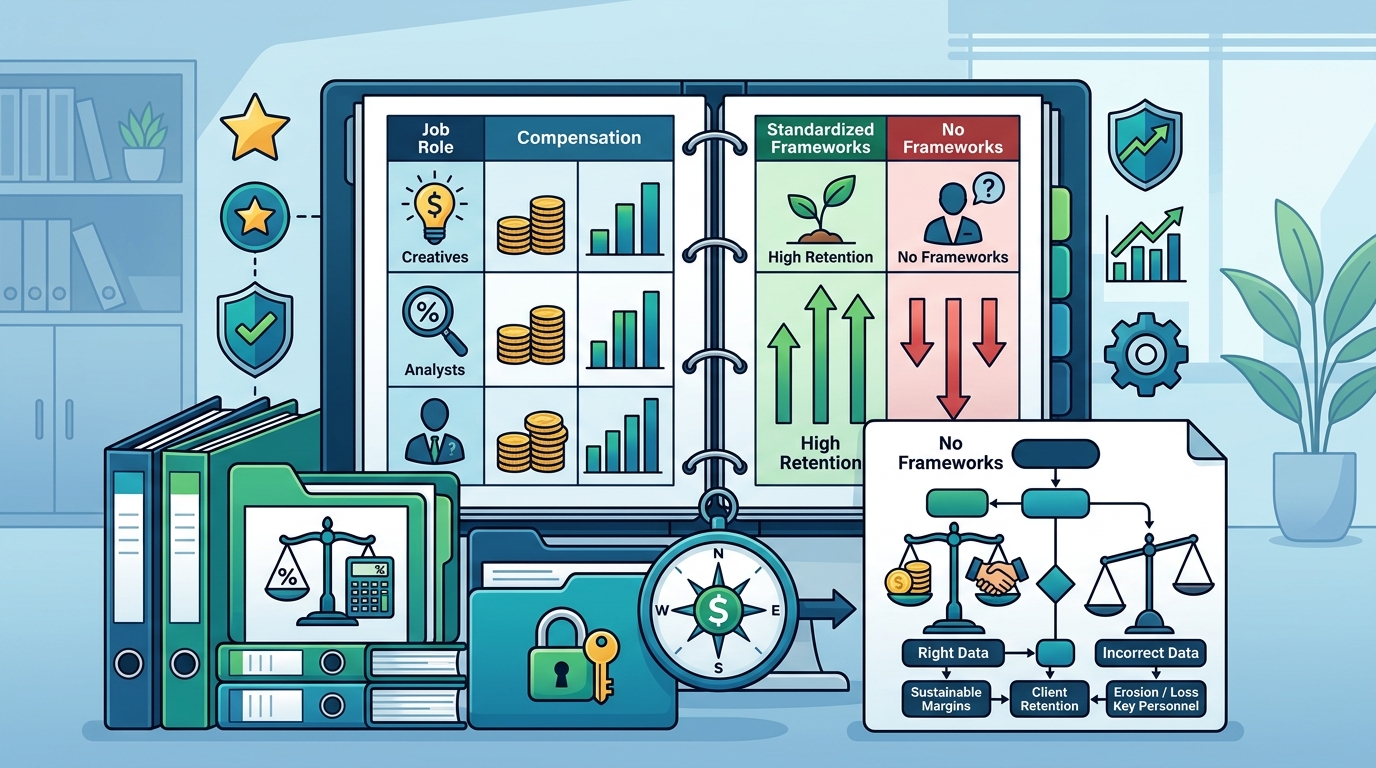
Compensation transparency is the single most effective lever for retaining top talent in the advertising industry. According to the AMI 2026 Salary Survey, agencies that utilize standardized compensation frameworks report a 22% higher retention rate among senior account executives. Without accurate benchmarking data, agency owners risk either overpaying and eroding margins or underpaying and losing critical client relationships to competitors. This guide details the most reliable sources for agency compensation data and how to leverage them for strategic advantage.
Why Standardization Matters in Agency Compensation
The advertising industry operates on a project-based model that creates volatile revenue streams. This volatility often leads to inconsistent compensation practices across departments. When an agency lacks a standardized salary structure, internal equity issues arise quickly. High-performing account managers often discover they are earning less than their peers at competing firms, leading to immediate turnover.
Standardization provides a clear framework for career progression. It allows agency owners to predict labor costs with greater accuracy. This predictability is essential for maintaining healthy profit margins during economic downturns. The AMI 2025 Research highlights that agencies with formalized compensation policies experience 15% lower turnover in key leadership roles.
Furthermore, standardized data supports objective performance reviews. It removes emotional bias from salary negotiations. When compensation is tied to clear market benchmarks, discussions become focused on value and performance rather than personal history. This shift creates a more professional and equitable workplace culture.
Top Survey Resources for Agency Owners
Finding accurate data requires accessing specialized industry reports. General labor surveys often fail to capture the nuances of creative and account management roles. The following resources provide the most granular data for independent marketing agencies.
Agency Management Institute (AMI) Salary Survey
The AMI Salary Survey is widely considered the gold standard for advertising agency compensation data. It provides detailed breakdowns by role, experience level, and geographic region. The survey covers everything from entry-level coordinators to C-suite executives. Access to this data is typically reserved for members, ensuring the integrity and specificity of the information.
AMI also offers the Agency Advantage program, which helps owners translate survey data into actionable business strategies. This resource is particularly valuable for agencies looking to align their compensation with industry best practices.
Industry-Specific Compensation Reports
Several specialized firms publish annual compensation reports tailored to the marketing sector. These reports often include data on bonuses, commissions, and equity stakes. They are essential for understanding the total compensation package rather than just base salary. Agencies should compare these reports against their own internal data to identify gaps.
Professional Association Data
Professional associations such as the Agency Management Institute provide exclusive access to member-only salary surveys. These surveys often have higher response rates from mid-sized agencies, providing a more accurate picture of the independent agency landscape. The data is anonymized to protect participant privacy while ensuring statistical significance.
Comparing Survey Methodologies
Not all salary surveys are created equal. Understanding the methodology behind the data is crucial for accurate benchmarking. Some surveys rely on self-reported data, which can be prone to inflation or deflation. Others use verified payroll data, offering higher accuracy but requiring more rigorous verification processes.
| Survey Type | Data Source | Accuracy Level | Best For |
|---|---|---|---|
| AMI Salary Survey | Verified Member Data | High | Agency Owners |
| General Labor Survey | Self-Reported | Medium | General HR Trends |
| Specialized Firm Report | Payroll Integration | Very High | Executive Compensation |
| Association Poll | Member Survey | Medium-High | Niche Roles |
When selecting a survey, consider the sample size and the demographic breakdown. A survey with 500 respondents from large enterprises will not accurately reflect the compensation trends of a small independent agency. Look for surveys that specifically segment data by agency size and revenue.
Benefits Benchmarking Beyond Salary
Base salary is only one component of total compensation. Benefits play a critical role in attracting and retaining talent. The 2026 AMI Webinars frequently discuss the evolving landscape of employee benefits in the advertising industry.
Key benefits to benchmark include health insurance premiums, retirement plan contributions, and paid time off. Creative professionals often value flexible work arrangements and professional development budgets highly. Account managers may prioritize performance-based bonuses and commission structures. Understanding these preferences allows agencies to tailor their benefits packages to specific roles.
Additionally, consider the cost of living adjustments in different geographic regions. A salary that is competitive in New York City may be insufficient in Austin, Texas, and vice versa. Use location-specific data to ensure your benefits package remains attractive across all your office locations.
Implementation Strategy for HR Teams
Acquiring salary data is only the first step. Implementing this data effectively requires a structured approach. Start by auditing your current compensation structure against the survey benchmarks. Identify roles that are significantly above or below the market median.
For roles below the market median, develop a phased adjustment plan. Sudden salary increases can strain cash flow. Instead, implement gradual raises aligned with performance reviews. For roles above the market median, analyze the reasons for the high compensation. Is it due to exceptional performance, or is it a result of historical inflation?
Communicate your compensation philosophy clearly to all employees. Transparency builds trust and reduces speculation. Use the Advertising Agency Consulting services to help develop a comprehensive compensation framework that aligns with your business goals.
Key Takeaways
- Agencies using standardized compensation frameworks report 22% higher retention rates.
- The AMI 2026 Salary Survey is the primary source for verified agency compensation data.
- AMI Research 2025 shows a 15% reduction in leadership turnover for agencies with formal policies.
- Benefits benchmarking must include health, retirement, and flexible work options.
- Geographic location significantly impacts competitive salary benchmarks.
- Phased salary adjustments are safer for cash flow than immediate market corrections.
- Transparency in compensation philosophy builds employee trust and reduces turnover.
Frequently Asked Questions
How often should agencies update their salary benchmarks?
Agencies should update their salary benchmarks annually. The advertising industry experiences rapid shifts in talent demand and economic conditions. Annual updates ensure that compensation remains competitive and aligned with current market realities.
Is the AMI Salary Survey available to non-members?
The comprehensive AMI Salary Survey is primarily available to members. However, AMI often releases summary reports and key findings in their blog and public resources. Non-members can access high-level trends through these channels.
What is the difference between base salary and total compensation?
Base salary is the fixed annual pay. Total compensation includes base salary plus bonuses, commissions, benefits, and equity. Benchmarking total compensation provides a more accurate picture of the true cost of employment and the value proposition to candidates.
How do I handle salary compression in my agency?
Salary compression occurs when new hires earn close to or more than tenured employees. To address this, conduct regular internal equity audits. Implement clear progression paths and merit-based increases for existing staff to maintain internal fairness.
Can small agencies afford comprehensive benefits packages?
Yes, small agencies can offer competitive benefits by leveraging group purchasing power and flexible work arrangements. Many small agencies partner with professional employer organizations (PEOs) to access better rates on health insurance and retirement plans.
What role does experience play in salary benchmarking?
Experience is a primary driver of salary variance. Surveys typically segment data by years of experience and job level. It is crucial to compare roles with similar experience levels to ensure accurate benchmarking. A senior account executive with 10 years of experience will command a significantly higher salary than one with 2 years.
Where can I find data on creative role salaries?
Specialized agency surveys, such as those from AMI, provide detailed data on creative roles. General labor surveys often lack the granularity needed for specific creative positions like art directors or copywriters. Use industry-specific sources for the most accurate data.
Get Your Custom Compensation Plan
Stop guessing and start benchmarking with precision. The Agency Management Institute provides the tools, data, and consulting you need to build a world-class compensation strategy. Schedule your consultation today to transform your agency's talent retention.