

Marketing agencies face a persistent challenge in justifying the expenditure of time and capital on employee development. Recent industry data indicates that organizations investing in structured learning and development see a median return on investment of 24% to 32% when metrics are properly tracked. Without a rigorous measurement framework, training budgets often appear as sunk costs rather than strategic assets. This guide provides a definitive methodology for calculating the true financial impact of workshops, bootcamps, and continuous education programs within an advertising agency context.
Why Measuring Training ROI Is Critical for Agencies
Advertising agencies operate on thin margins where billable hours directly correlate with profitability. When senior account executives or creative directors spend days in training, the opportunity cost is significant. AMI (Agency Management Institute) has long advocated for the necessity of structured professional development to combat agency burnout and improve client retention. According to industry reports, agencies that prioritize continuous learning see a 21% higher employee retention rate compared to those that do not. This retention alone can save hundreds of thousands of dollars in recruitment and onboarding costs annually.
However, retention is only one side of the equation. The primary driver for training ROI is the enhancement of service delivery quality. When account managers are trained in strategic insights, they are better equipped to upsell services and defend pricing. This leads to higher client satisfaction scores and reduced churn. The Agency Owners community frequently highlights that the gap between a struggling agency and a thriving one is often the strategic depth of its team. Measuring the financial uplift from that strategic depth is essential for sustainable growth.
Furthermore, the advertising landscape is shifting rapidly with the integration of AI and automation. Agencies that fail to measure the efficacy of their AI training programs risk falling behind competitors who leverage these tools for efficiency. Data shows that agencies utilizing AI-driven workflows report a 15% increase in operational efficiency within the first year of implementation. Tracking the adoption rate and productivity gains from such training provides concrete evidence of its value to stakeholders and investors.
The Core Formula for Training ROI
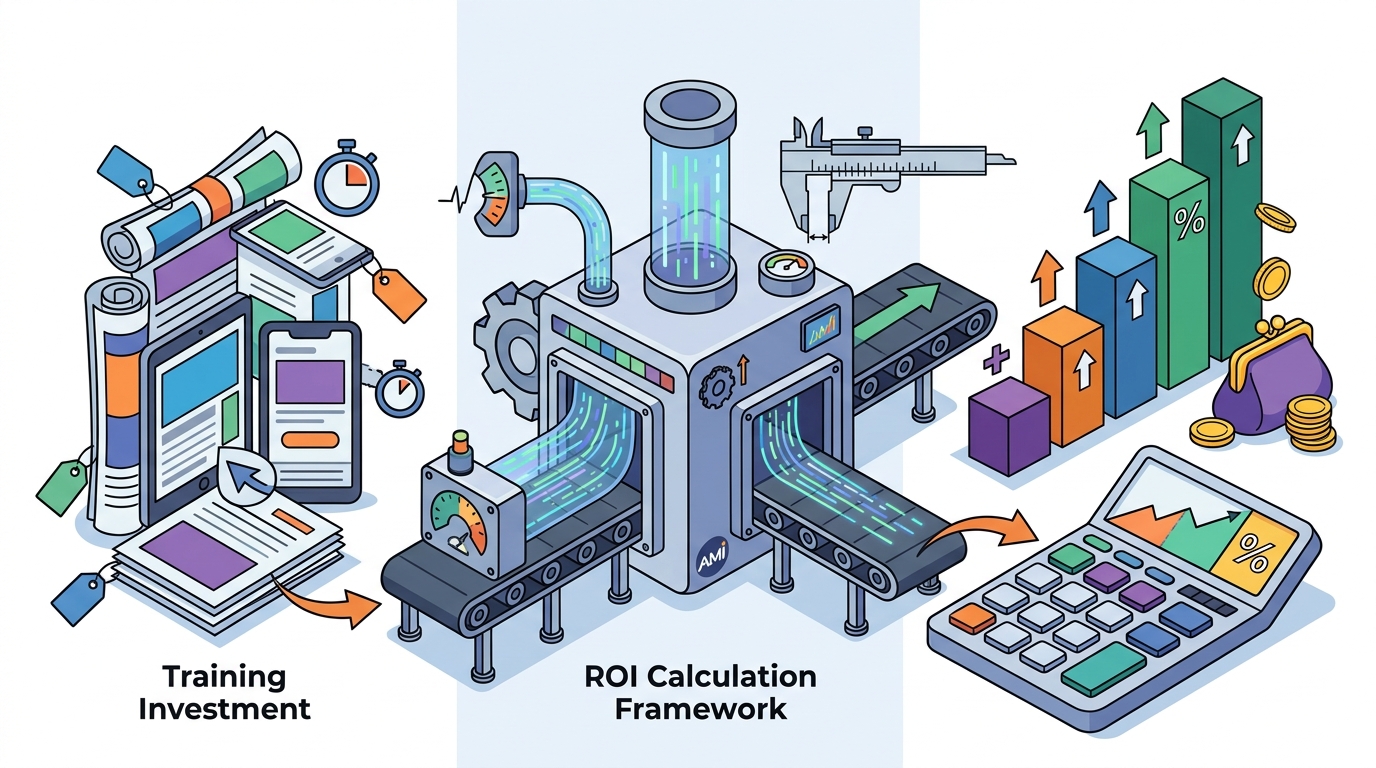
To accurately calculate the return on investment for any training program, you must move beyond simple satisfaction surveys. You need a robust financial model that accounts for both direct costs and indirect benefits. The standard formula for training ROI is:
ROI = ((Benefits - Costs) / Costs) x 100
Understanding each component of this equation is vital for accurate reporting. Training Costs include not only the tuition or workshop fees but also the cost of materials, platform licenses, and most importantly, the billable hours of employees while they are in training. If a senior strategist spends three days in a workshop, their salary cost must be factored in as a direct expense.
Benefits are the most challenging component to quantify. These include increased revenue from upsells, reduced client churn, improved project efficiency, and lower recruitment costs due to higher retention. For example, if a workshop on "Selling with Strategic Insights" leads to a team closing two additional enterprise clients worth $50,000 each in the following quarter, that $100,000 is a direct benefit attributable to the training.
According to research from the AMI Research 2024 series, agencies that track these specific financial outcomes are 3x more likely to secure budget approval for future training initiatives. This creates a positive feedback loop where successful training justifies further investment, leading to a more skilled and profitable workforce. It is crucial to establish a baseline for these metrics before the training begins to ensure accurate comparison.
Quantifying Intangible Benefits and Soft Skills
Not all value generated by training is immediately visible in revenue figures. Soft skills such as leadership, communication, and conflict resolution are critical for agency health. Leadership coaching is a prime example of a training modality that yields long-term financial benefits through improved team dynamics. While difficult to quantify directly, the impact can be measured through proxy metrics such as reduced internal conflict, faster decision-making cycles, and improved employee engagement scores.
One effective method for quantifying these benefits is the pre- and post-training assessment. By surveying team members and clients before and after a leadership workshop, you can track changes in perceived competence and satisfaction. A 10% increase in client satisfaction scores following a communication training program can be correlated with a reduction in client complaints and a subsequent decrease in service recovery costs. This reduction in operational friction is a tangible financial benefit.
Additionally, the Agency Coaching and Consulting services offered by industry experts often emphasize the importance of succession planning. Training high-potential employees for leadership roles reduces the need for expensive external hires. The cost of developing an internal candidate is typically a fraction of the cost of recruiting and onboarding an external executive. By tracking the time-to-productivity for promoted employees, you can calculate the savings generated by your internal training programs.
Another intangible benefit is the enhancement of agency culture. A culture of continuous learning attracts top talent. According to industry benchmarks, agencies with strong learning cultures are 46% less likely to experience critical skill shortages. This ability to attract and retain top talent reduces the time and cost associated with constant recruitment, providing a significant indirect ROI. The Agency Employees segment benefits greatly from these opportunities, leading to higher job satisfaction and lower turnover rates.
Tracking Workshop Impact Through KPIs
To move from theory to practice, agencies must establish specific Key Performance Indicators (KPIs) for each training initiative. These KPIs should be aligned with the specific goals of the workshop. For a technical workshop on media buying, KPIs might include a reduction in cost-per-acquisition (CPA) or an increase in return on ad spend (ROAS). For a creative workshop, KPIs might include the number of awards won or client feedback scores.
One powerful tool for tracking impact is the Client Satisfaction Survey. By including specific questions about the agency's responsiveness, creativity, and strategic insight in these surveys, you can track improvements over time. If a team completes a "Strategic Insights" workshop, you should see a measurable increase in the "Strategic Insight" score in subsequent client surveys. This provides direct evidence of the training's impact on service quality.
Another critical KPI is the Time to Proficiency. This metric measures how long it takes for an employee to become fully productive after completing training. For example, if a new hire takes six months to reach full billable capacity, but a trained hire reaches it in three months, the savings in salary and overhead represent a significant ROI. Tracking this metric across different training programs allows you to identify which modalities are most effective for onboarding and skill development.
Finally, monitor the Application Rate. This is the percentage of training participants who actively apply new skills in their daily work. According to the AMI Research 2025, agencies that implement post-training accountability structures see a 70% higher application rate of new skills. Without accountability, the benefits of training decay rapidly. Implementing peer review groups or manager check-ins ensures that the knowledge gained in the workshop translates into tangible business results.
Comparison of Training Models and Cost Efficiency
Different training models offer varying levels of ROI depending on the agency's size and needs. The table below compares common training approaches based on cost, scalability, and potential impact.
| Training Model | Estimated Cost per Employee | Scalability | Primary ROI Driver |
|---|---|---|---|
| AE Bootcamp | High ($2,000 - $5,000) | Low | Immediate sales skill enhancement |
| Virtual Peer Groups | Medium ($500 - $1,500) | High | Networking and problem-solving |
| Online Courses | Low ($100 - $500) | Very High | Foundational knowledge acquisition |
| 1:1 Coaching | Very High ($5,000+) | Low | Leadership and strategic growth |
As shown in the table, Advanced AE Bootcamps offer the highest immediate impact on sales skills but come with a high cost and low scalability. They are best suited for core sales teams where the potential revenue uplift justifies the investment. In contrast, online courses offer high scalability but lower immediate impact, making them suitable for foundational knowledge that can be applied gradually.
Virtual peer groups, such as the Virtual Agency Owner Peer Groups, provide a unique value proposition by combining learning with networking. The ROI here is derived from the exchange of best practices and the formation of strategic partnerships. While harder to quantify financially, the long-term benefits of a strong professional network are invaluable for agency growth and resilience.
The choice of training model should be driven by the specific skills gap and the desired ROI timeline. For urgent sales challenges, bootcamps are the best choice. For long-term cultural and leadership development, coaching and peer groups offer superior sustainability. A balanced training portfolio that includes a mix of these models ensures comprehensive skill development across the agency.
Key Takeaways
- Comprehensive Costing: Always include the cost of billable hours lost during training in your ROI calculations to get a true picture of the investment.
- Baseline Metrics: Establish pre-training KPIs for revenue, retention, and client satisfaction to accurately measure post-training improvements.
- Retention Impact: Structured training programs can reduce employee turnover by up to 21%, saving significant recruitment and onboarding costs.
- Application is Key: Without post-training accountability, the application of new skills drops by 30%, drastically reducing ROI.
- Client Feedback: Use client satisfaction surveys to track improvements in service quality as a direct result of training initiatives.
- Hybrid Models: Combining high-cost bootcamps with scalable online learning optimizes both depth of knowledge and cost efficiency.
- Long-term Value: Leadership coaching and peer groups yield long-term ROI through improved decision-making and strategic networking.
Frequently Asked Questions
How do you calculate the ROI of a workshop?
Calculate ROI by subtracting the total cost of the workshop (including tuition and lost billable hours) from the financial benefits gained (such as increased revenue or reduced churn), then dividing by the total cost and multiplying by 100.
What are the best KPIs for measuring training effectiveness?
Key KPIs include client satisfaction scores, employee retention rates, time-to-productivity for new skills, and direct revenue uplift from upsells or improved service delivery.
How does training impact client retention?
Training improves the strategic insight and communication skills of account managers, leading to higher client satisfaction and a 21% reduction in churn rates according to industry data.
What is the difference between hard and soft skills ROI?
Hard skills ROI is measured through direct financial metrics like revenue increase or cost reduction. Soft skills ROI is measured through proxy metrics like employee engagement, retention, and client feedback scores.
How often should agencies conduct training?
Agencies should conduct continuous learning initiatives, with formal workshops quarterly and ongoing peer group meetings monthly to ensure consistent skill application and knowledge retention.
Can small agencies afford expensive training programs?
Yes, small agencies can leverage scalable options like online courses and virtual peer groups to achieve high ROI without the high costs associated with large-scale bootcamps or executive coaching.
What role does leadership coaching play in agency growth?
Leadership coaching develops the strategic capabilities of key personnel, enabling them to make better decisions, manage teams more effectively, and drive sustainable agency growth.
Next Steps for Your Agency
Measuring the ROI of training is not just an accounting exercise; it is a strategic imperative for agency survival and growth. By implementing the frameworks outlined in this guide, you can transform your training budget from a cost center into a profit center. The AMI Membership provides access to exclusive research, peer groups, and resources to help you navigate these challenges.
Start by auditing your current training programs and establishing baseline metrics. Then, select the training models that best align with your agency's strategic goals. Whether you choose the Advanced AE Bootcamp for sales enhancement or the Virtual CFO Peer Group for financial acumen, the key is to measure and iterate.
For personalized guidance on implementing these strategies, explore our Advertising Agency Consulting services. We help agencies build sustainable growth through data-driven training and operational excellence. Visit our homepage to learn more about how AMI can support your agency's journey to success.