

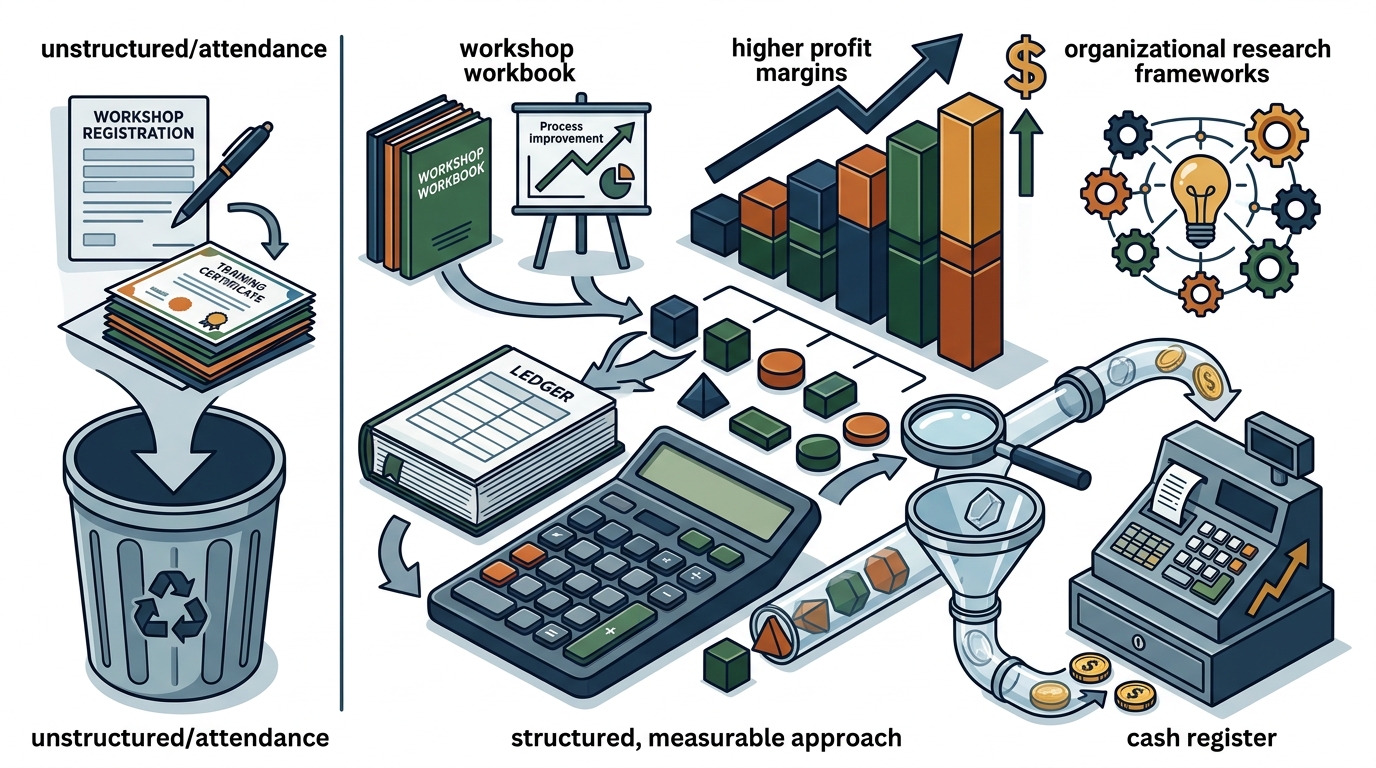
Organizations that systematically track educational investments consistently report higher profit margins than their unstructured counterparts. According to organizational research frameworks, structured learning initiatives drive measurable performance gains across modern business ecosystems. Agency leaders must move beyond simple attendance tracking to evaluate actual skill transfer and revenue impact. This guide outlines the exact methodologies required to calculate workshop returns accurately. You will learn how to align training outcomes with core business objectives and scale your operational efficiency.
Defining Training Value in Agency Contexts
Workshop return on investment represents the financial difference between program costs and the resulting operational improvements. Agency employee development metrics track how staff apply new methodologies to daily client deliverables. Advertising agency training evaluation requires a structured approach to measuring knowledge retention and practical application. You must establish clear success criteria before launching any educational initiative. This prevents wasted budget and ensures every session aligns with strategic growth targets.
Training is a structured educational intervention designed to close specific skill gaps within a workforce. Development is the continuous process of applying learned concepts to real-world business challenges. Evaluation is the systematic measurement of program effectiveness against predefined organizational benchmarks. When agency leaders define these terms precisely, they eliminate ambiguity from the planning phase. This clarity allows you to design workshops that directly support revenue generation and client retention.
Consider how your current curriculum addresses emerging industry demands. Modern advertising requires rapid adaptation to algorithmic changes and shifting consumer behaviors. Your training programs must reflect these realities to remain relevant. Advertising Agency Training provides a proven framework for aligning educational content with market demands. You can leverage these established methodologies to build a more resilient team structure.
Establishing Baseline Performance Metrics
Before launching any educational initiative, you must document current performance levels. This baseline serves as your control group for measuring future improvements. Track key indicators such as proposal win rates, client retention percentages, and average project margins. These numbers establish your starting point and highlight specific areas requiring intervention. Without accurate baseline data, you cannot calculate meaningful returns after program completion.
Research indicates that organizations implementing structured baseline tracking experience faster performance recovery. Organizational research frameworks emphasize the importance of data-driven decision making. You should audit your current workflow bottlenecks and identify which skills directly impact revenue. This audit reveals exactly where educational interventions will yield the highest returns. Focus your initial workshops on the highest-impact operational gaps.
Document your existing pricing models, subscription tiers, and service delivery methods. These operational specifics determine how training translates into billable hours and project profitability. When you map skill improvements directly to revenue-generating activities, you create a clear financial justification for educational budgets. This alignment ensures that every training dollar contributes to measurable business growth.
Tracking Post-Workshop Behavioral Shifts
Attendance records do not equal skill acquisition. You must track how participants apply new methodologies to active client accounts. Implement structured observation periods where managers review deliverables for specific training concepts. This hands-on verification ensures that theoretical knowledge translates into practical execution. You should schedule follow-up assessments at thirty, sixty, and ninety days post-workshop.
Behavioral shifts manifest as faster project turnaround times, improved client communication, and reduced revision cycles. These operational improvements directly correlate with higher profit margins and increased client satisfaction. Advertising Agency Consulting methodologies emphasize continuous feedback loops to sustain long-term performance gains. You can integrate these feedback mechanisms into your existing project management workflows. This integration ensures that training outcomes remain visible and actionable over time.
Monitor how your team handles complex client requests after completing advanced workshops. Do they propose more strategic solutions? Do they negotiate contracts with greater confidence? These qualitative shifts often precede quantitative revenue increases. Tracking them provides early indicators of program success. Adjust your curriculum based on these real-time observations to maximize future cohort performance.
Calculating Direct Revenue Attribution
Direct revenue attribution links specific training modules to closed deals and expanded accounts. You must track which proposals include newly taught methodologies and calculate their win rates. Compare these figures against historical baseline data to determine the exact financial impact. This calculation reveals whether your educational investments directly drive top-line growth. You should assign unique tracking codes to workshop-specific proposals to simplify this process.
Revenue attribution requires precise tracking of proposal win rates, client retention percentages, and average project margins. These metrics establish your starting point and highlight specific areas requiring intervention. When you map skill improvements directly to revenue-generating activities, you create a clear financial justification for educational budgets. This alignment ensures that every training dollar contributes to measurable business growth. Agency Advantage frameworks provide structured approaches to aligning educational content with market demands. You can leverage these established methodologies to build a more resilient team structure.
Calculate the total cost of program delivery, including facilitator fees, materials, and staff time away from billable work. Subtract this total from the net profit generated by workshop-influenced projects. The resulting figure represents your direct financial return. If the number remains positive, your training program operates as a profit center rather than an expense. Scale successful modules and phase out underperforming ones to optimize your educational portfolio.
Evaluating Retention and Succession Outcomes
Employee retention rates often improve significantly after targeted skill development initiatives. Staff members who receive continuous education report higher job satisfaction and stronger organizational loyalty. You should track turnover percentages before and after implementing structured training programs. Lower attrition directly reduces recruitment costs and preserves institutional knowledge. This retention benefit frequently offsets the initial financial investment in educational programs.
Succession planning relies heavily on internal talent development rather than external hiring. You must identify high-potential employees and route them through advanced leadership workshops. These programs prepare your next generation of directors and partners to handle increased responsibilities. Agency Employees development frameworks emphasize the importance of building internal leadership pipelines. You can integrate these succession strategies into your annual performance review cycles. This integration ensures that training directly supports long-term organizational stability.
Measure the time required to promote workshop graduates into senior roles. Compare this timeline against industry standards and your previous promotion cycles. Faster internal promotions indicate highly effective knowledge transfer and leadership preparation. You should also track client satisfaction scores for accounts managed by recently promoted staff. These combined metrics provide a comprehensive view of your training program's long-term impact.
| Training Component | Measurement Method | Primary Business Impact | Implementation Complexity |
|---|---|---|---|
| Proposal Strategy Workshops | Win rate tracking and margin analysis | Increased closed deal value | Low |
| Leadership Development Programs | Internal promotion velocity and retention rates | Reduced recruitment costs | Medium |
| Client Success Methodologies | Net promoter scores and contract renewal percentages | Extended client lifetime value | Medium |
| Operational Efficiency Bootcamps | Project turnaround time and revision cycle reduction | Higher billable hour utilization | Low |
Key Takeaways
- Workshop return on investment requires precise baseline tracking before program launch.
- Behavioral shifts manifest as faster project turnaround times and improved client communication.
- Direct revenue attribution links specific training modules to closed deals and expanded accounts.
- Employee retention rates often improve significantly after targeted skill development initiatives.
- Succession planning relies heavily on internal talent development rather than external hiring.
- Organizational research frameworks emphasize the importance of data-driven decision making. (Statistical Resources Tourism)
- Scaling successful modules and phasing out underperforming ones optimizes your educational portfolio.
Frequently Asked Questions
How do you calculate the exact financial return of a single workshop?
Subtract the total program delivery costs from the net profit generated by workshop-influenced projects. This calculation reveals whether your educational investments directly drive top-line growth. You should assign unique tracking codes to workshop-specific proposals to simplify this process.
What metrics best indicate successful skill transfer after training?
Track proposal win rates, client retention percentages, and average project margins. These indicators establish your starting point and highlight specific areas requiring intervention. When you map skill improvements directly to revenue-generating activities, you create a clear financial justification for educational budgets.
How long should you wait before measuring training effectiveness?
Schedule follow-up assessments at thirty, sixty, and ninety days post-workshop. This timeline allows participants to apply new methodologies to active client accounts. Behavioral shifts manifest as faster project turnaround times, improved client communication, and reduced revision cycles.
Can training programs directly impact employee retention rates?
Staff members who receive continuous education report higher job satisfaction and stronger organizational loyalty. You should track turnover percentages before and after implementing structured training programs. Lower attrition directly reduces recruitment costs and preserves institutional knowledge.
What is the most effective way to track workshop-influenced proposals?
Assign unique tracking codes to workshop-specific proposals and calculate their win rates. Compare these figures against historical baseline data to determine the exact financial impact. This calculation reveals whether your educational investments directly drive top-line growth.
How do you integrate training outcomes into annual performance reviews?
Document your existing pricing models, subscription tiers, and service delivery methods. These operational specifics determine how training translates into billable hours and project profitability. When you map skill improvements directly to revenue-generating activities, you create a clear financial justification for educational budgets.
Next Steps for Agency Leaders
Implement these measurement frameworks immediately to transform your educational budgets into profit centers. Schedule a comprehensive operational audit to identify your highest-impact training gaps. Agency Management Institute provides the exact methodologies required to align educational content with market demands. You can leverage these established frameworks to build a more resilient team structure. Book your strategic planning session today and start measuring your training returns with precision.