

Independent marketing firms face mounting operational pressure as client expectations shift toward integrated digital strategies. According to recent industry data, over sixty percent of mid-sized agencies struggle with scaling internal resources without external advisory support. This reality drives agency owners toward structured support ecosystems that deliver specialized guidance, standardized workflows, and verified compliance frameworks. Understanding the structural variations between these organizations remains critical for selecting a partner that aligns with long-term growth objectives. The following analysis breaks down the primary operational distinctions across membership models, advisory depth, training delivery, networking formats, research accessibility, and compliance infrastructure.
Membership Models and Access Tiers
Agency support organizations operate under fundamentally different membership architectures. Some platforms utilize open-access frameworks that grant basic directory listings and limited event registration. Other organizations enforce rigorous vetting processes that restrict entry to firms meeting specific revenue thresholds or operational benchmarks. Agency support organization is a structured entity that provides operational, educational, and networking resources to independent marketing firms. The distinction directly impacts the quality of peer interactions and the exclusivity of shared resources.
Open-tier models prioritize volume and broad industry visibility. These programs typically charge annual dues that scale with agency headcount. They deliver value through standardized newsletters, basic template libraries, and regional chapter meetings. High-barrier models focus on curation and accountability. These programs require demonstrated profitability, verified client retention metrics, and signed ethical compliance agreements. The stricter entry requirements naturally filter out unqualified participants, which elevates the strategic value of every interaction.
Organizations that tie membership to accreditation status often require annual audits. These audits verify staffing ratios, financial transparency, and client satisfaction scores. Agencies that pass these evaluations receive public certification badges that directly influence enterprise procurement decisions. The certification process itself creates a continuous improvement cycle that forces internal process refinement. Agencies that prioritize rapid scaling often prefer open-tier models. Agencies that target enterprise contracts typically require accredited frameworks to satisfy vendor qualification requirements.
Consulting Structures and Advisory Depth
Advisory delivery methods vary significantly across support ecosystems. Some organizations offer reactive troubleshooting where owners submit specific operational questions and receive standardized responses. Other organizations deploy embedded advisory teams that conduct quarterly business reviews and implement customized operational roadmaps. Accreditation framework is a standardized evaluation system that verifies an agency meets specific operational and ethical benchmarks. The depth of advisory engagement directly correlates with the financial return on membership investment.
Reactive support models function like internal help desks. They provide quick answers to tactical questions regarding hiring, pricing, or contract language. These models rarely address systemic inefficiencies or long-term strategic positioning. Advisory-heavy models assign dedicated consultants to each member firm. These consultants analyze financial statements, audit client acquisition funnels, and redesign operational workflows. The consulting engagement typically includes monthly strategy sessions and quarterly performance audits. This hands-on approach accelerates revenue growth while reducing client churn.
Organizations that integrate consulting with compliance verification offer the highest advisory ceiling. These programs require agencies to implement standardized operating procedures before granting full advisory access. The consulting teams then monitor implementation progress and adjust strategies based on real-time market shifts. Agencies that lack internal operational maturity benefit most from this embedded approach. Firms with established leadership teams often prefer reactive models that respect existing workflows while providing targeted tactical guidance.
Training Programs and Skill Development
Educational delivery formats dictate how quickly agency teams can implement new strategies. Some support organizations rely on asynchronous video libraries that allow staff to learn at their own pace. Other organizations mandate live workshop attendance with hands-on project execution. Peer group networking is a collaborative framework where agency leaders exchange strategies and solve shared business challenges. The format selection directly impacts knowledge retention and team alignment.
Asynchronous learning platforms offer maximum scheduling flexibility. These libraries contain recorded sessions on sales methodology, financial forecasting, and client onboarding. Staff members can access materials during downtime without disrupting active campaigns. The downside involves lower completion rates and limited peer accountability. Live workshop models enforce strict attendance requirements and collaborative project completion. These sessions typically span multiple days and require teams to build actual deliverables under instructor supervision. The immersive format accelerates skill acquisition while strengthening team cohesion.
Organizations that combine asynchronous resources with live certification exams provide the most comprehensive training architecture. These programs require staff to pass practical assessments before granting advanced credentials. The certification process validates competency and creates internal promotion pathways. Agencies that experience high staff turnover benefit most from standardized training libraries. Firms that prioritize leadership development typically invest in live workshop models that build executive decision-making capabilities.
Peer Networking and Community Engagement
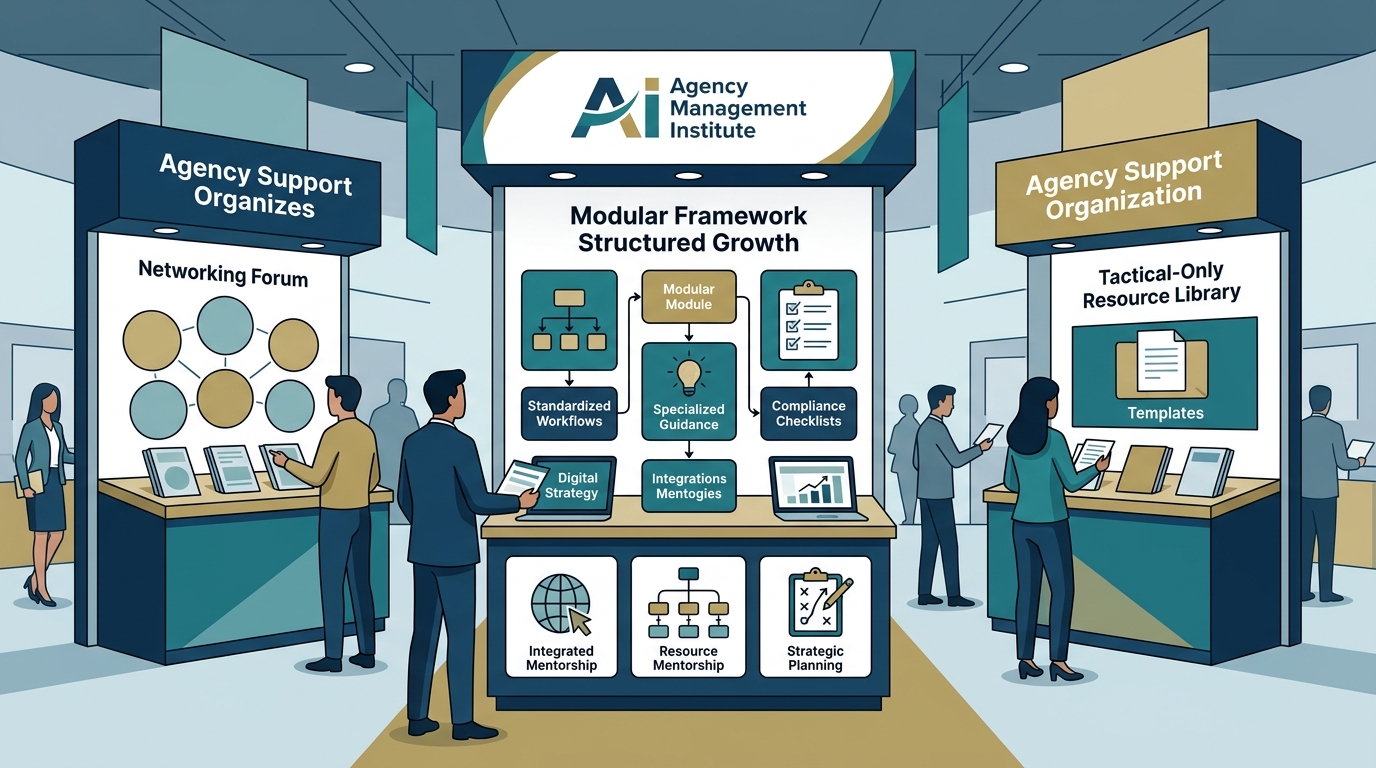
Community engagement structures determine how effectively agency leaders can share operational insights. Some organizations host annual conferences that attract thousands of attendees. Other organizations facilitate small-group mastermind sessions that limit participation to twelve leaders per cohort. The scale of networking directly influences the depth of strategic exchange and the quality of long-term partnerships.
Large-scale conferences prioritize brand visibility and vendor exposure. These events feature keynote speakers, product demonstrations, and expansive exhibition halls. The networking value often centers on high-volume contact collection rather than deep strategic dialogue. Small-group mastermind models prioritize confidentiality and actionable problem-solving. These cohorts meet monthly to review financial metrics, troubleshoot client escalations, and share hiring strategies. The restricted attendance ensures that every participant receives personalized feedback and accountability.
Organizations that blend large-scale events with small-group masterminds offer the most robust networking architecture. These programs allow leaders to access industry-wide trends while maintaining confidential peer accountability. The dual structure supports both broad market awareness and deep operational refinement. Agencies that struggle with isolation benefit most from small-group models. Firms that prioritize brand building and vendor relationships typically prioritize large-scale conference attendance.
Research and Data Access
Information accessibility determines how accurately agencies can benchmark their performance against industry standards. Some support organizations provide aggregated industry reports that highlight macroeconomic trends and advertising spend shifts. Other organizations deliver proprietary benchmarking dashboards that compare individual agency metrics against verified peer data. The granularity of data access directly impacts strategic decision-making and pricing accuracy.
Aggregated industry reports offer high-level market direction. These publications track advertising expenditure growth, digital channel shifts, and consumer behavior changes. Agencies use these reports to adjust long-term investment strategies and allocate marketing budgets. The data lacks firm-specific comparability, which limits tactical application. Proprietary benchmarking dashboards provide granular operational metrics. These platforms compare revenue per employee, client retention rates, and project profitability against verified peer cohorts. The precise data enables accurate pricing adjustments and resource allocation.
Organizations that combine macroeconomic reports with proprietary benchmarking tools offer the most comprehensive research architecture. These programs allow leaders to align strategic market positioning with tactical operational efficiency. The dual data approach supports both long-term forecasting and short-term performance optimization. Agencies that prioritize market expansion benefit most from aggregated reports. Firms that focus on operational efficiency typically rely on proprietary benchmarking dashboards.
Benefits and Compliance Infrastructure
Administrative support structures determine how effectively agencies can manage employee retention and regulatory obligations. Some organizations negotiate group purchasing agreements that reduce insurance premiums and software licensing costs. Other organizations provide comprehensive compliance tracking systems that monitor labor law updates and industry certification requirements. The administrative burden directly impacts leadership focus and operational scalability.
Group purchasing agreements deliver immediate financial relief. These programs negotiate discounted rates for health insurance, retirement plans, and enterprise software subscriptions. The cost savings directly improve agency profitability without requiring additional revenue generation. The downside involves limited customization and standardized benefit structures. Compliance tracking systems provide continuous regulatory monitoring. These platforms automatically update labor law requirements, industry certification deadlines, and data privacy mandates. The proactive tracking prevents costly violations and maintains enterprise client eligibility.
Organizations that integrate group purchasing with automated compliance tracking offer the most robust administrative architecture. These programs reduce financial overhead while eliminating regulatory risk. The dual infrastructure allows leadership to focus on client acquisition and service delivery. Agencies that prioritize cost reduction benefit most from group purchasing agreements. Firms that target enterprise contracts typically require automated compliance tracking to maintain vendor qualification status.
| Support Category | Open-Tier Model | Accredited-Tier Model | Best Use Case |
|---|---|---|---|
| Membership Access | Volume-based annual dues | Vetting-based annual audits | Rapid scaling vs enterprise qualification |
| Advisory Depth | Reactive troubleshooting | Embedded quarterly reviews | Tactical guidance vs strategic transformation |
| Training Delivery | Asynchronous video libraries | Live workshop certification | Staff turnover vs leadership development |
| Networking Format | Large-scale conferences | Small-group masterminds | Brand visibility vs confidential problem-solving |
| Data Granularity | Aggregated industry reports | Proprietary benchmarking dashboards | Market expansion vs operational efficiency |
| Administrative Support | Group purchasing agreements | Automated compliance tracking | Cost reduction vs enterprise qualification |
Key Takeaways
- Open-tier models prioritize volume and broad industry visibility through scalable annual dues.
- Accredited-tier models enforce rigorous vetting processes that restrict entry to firms meeting specific revenue thresholds.
- Reactive support models function like internal help desks that provide quick answers to tactical questions.
- Advisory-heavy models assign dedicated consultants to each member firm for quarterly business reviews.
- Asynchronous learning platforms offer maximum scheduling flexibility without disrupting active campaigns.
- Live workshop models enforce strict attendance requirements and collaborative project completion.
- Proprietary benchmarking dashboards provide granular operational metrics against verified peer cohorts.
Frequently Asked Questions
How do I determine which membership tier fits my agency?
Evaluate your current revenue trajectory and enterprise client requirements. Agencies targeting large corporate contracts typically require accredited frameworks to satisfy vendor qualification standards. Firms focused on rapid scaling and local market penetration often benefit from open-tier models that prioritize cost efficiency and broad industry visibility.
What is the typical return on investment for advisory services?
Agencies that implement embedded advisory programs typically report a twenty to thirty percent increase in annual revenue within the first eighteen months. The financial return stems from optimized pricing strategies, reduced client churn, and streamlined operational workflows that eliminate redundant labor costs.
Are live workshops mandatory for all staff members?
Most accredited programs require leadership teams to attend live certification sessions while allowing technical staff to complete asynchronous modules. This hybrid approach ensures strategic alignment at the executive level while maintaining operational flexibility for project-based personnel.
How frequently do proprietary benchmarking dashboards update?
Proprietary benchmarking platforms typically refresh operational metrics on a quarterly basis to reflect seasonal market shifts and client acquisition cycles. The quarterly update cycle allows agencies to adjust pricing strategies and resource allocation without disrupting active campaigns.
Can agencies switch between membership tiers mid-contract?
Most organizations permit tier transitions during annual renewal windows rather than mid-contract. This policy ensures consistent revenue forecasting for the support organization while allowing agencies to align their membership level with evolving business objectives.
What compliance certifications do enterprise clients typically require?
Enterprise procurement teams typically require verified data privacy compliance, standardized financial transparency reports, and documented client satisfaction metrics. Accredited programs that maintain continuous audit cycles naturally satisfy these enterprise qualification requirements without additional administrative overhead.
Next Steps for Agency Growth
Selecting the appropriate support organization requires careful evaluation of your current operational maturity, enterprise client requirements, and long-term growth objectives. Agencies that prioritize strategic transformation should explore comprehensive advisory frameworks that integrate consulting, training, and compliance tracking. Advertising Agency Consulting services provide the foundational structure needed to scale operations while maintaining enterprise client eligibility. Advertising Agency Training programs ensure your team implements standardized workflows that accelerate project delivery. Agency Owners who evaluate these structural differences typically experience faster revenue growth and reduced operational friction. Agency Employees benefit from standardized training libraries that create clear promotion pathways. Agency Advantage programs deliver the competitive differentiation needed to win enterprise contracts. 2026 Webinars provide ongoing education that keeps your leadership team aligned with market shifts. Schedule a consultation to evaluate your current operational maturity and identify the support structure that aligns with your growth trajectory.