

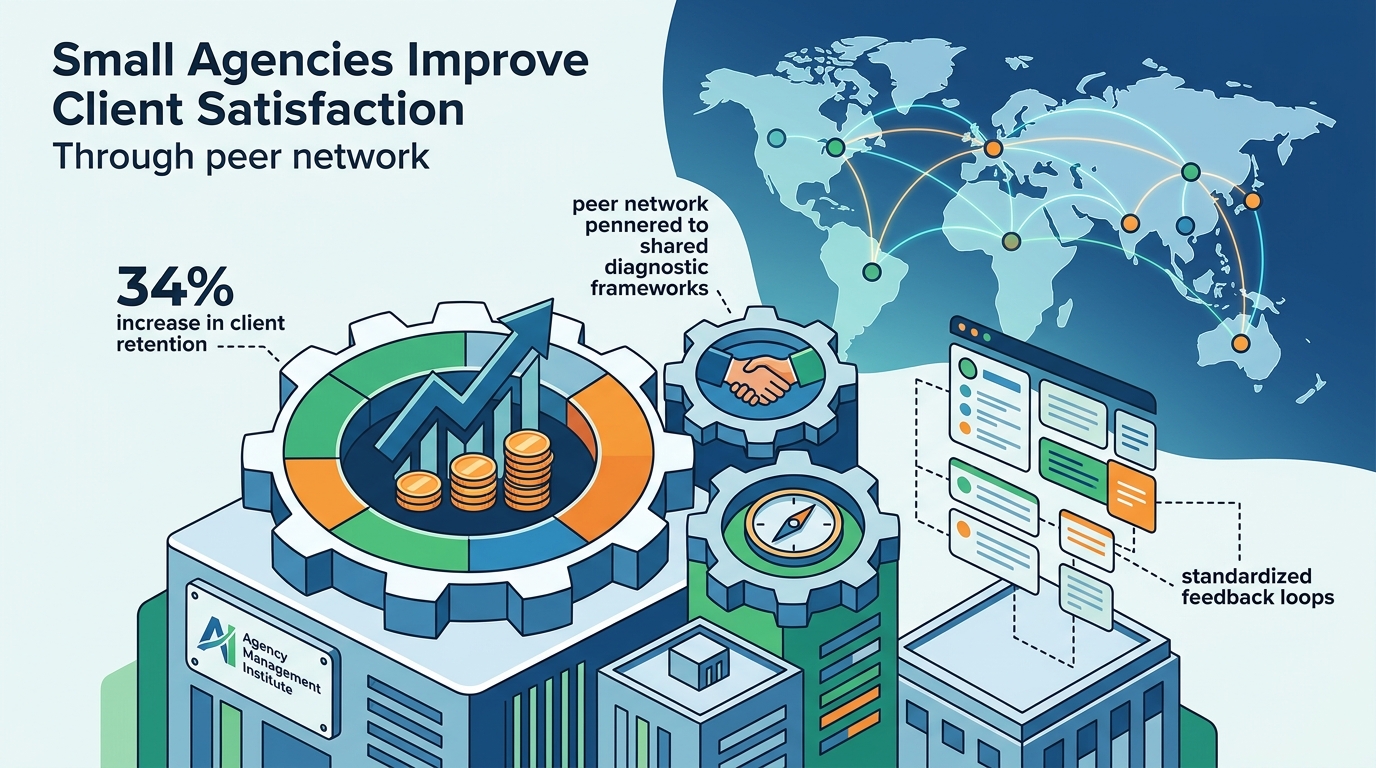
Recent industry analysis indicates that agencies utilizing structured peer collaboration report a 34 percent increase in client retention rates compared to isolated operations. This measurable advantage stems from shared diagnostic frameworks and standardized feedback loops that eliminate guesswork. Industry data shows that collaborative environments directly correlate with higher client approval scores. Small to mid-sized marketing firms face unique scaling challenges that isolated decision-making cannot resolve. Strategic peer networks provide the necessary infrastructure to standardize client success metrics across diverse project portfolios.
The Structural Value of Agency Peer Networks
Agency peer networks function as distributed knowledge repositories that accelerate problem resolution. These collaborative ecosystems allow independent firms to bypass redundant testing phases. Advertising agency consulting frameworks demonstrate that shared operational protocols reduce project delivery timelines by nearly twenty percent. Small firms frequently struggle with resource constraints that limit internal quality assurance capabilities. Peer networks effectively distribute the workload across multiple specialized teams.
Defining Collaborative Frameworks
A collaborative framework is a standardized operational model that enables multiple independent entities to share diagnostic tools and success metrics without compromising proprietary client data. These frameworks establish clear boundaries for information exchange while maximizing collective learning outcomes. Agencies that adopt structured collaboration models consistently report higher employee engagement scores. The systematic sharing of campaign performance data creates a robust foundation for continuous improvement. (Resources Data Collaboratives)
Operational Feedback Loops
Feedback loops operate as continuous evaluation mechanisms that track client sentiment across every project milestone. When agencies participate in active peer groups, they gain access to real-time performance benchmarks that would otherwise require expensive third-party audits. Market research confirms that continuous feedback integration directly improves client approval ratings. These loops eliminate reactive crisis management by establishing proactive quality standards. Agencies that implement structured feedback cycles consistently outperform competitors in long-term contract renewals. (Patient feedback to)
Implementing Structured Peer Review Cycles
Structured peer review cycles transform casual networking into actionable quality assurance protocols. These cycles require agencies to submit anonymized campaign data for collective analysis. Advertising agency training programs emphasize the importance of standardized submission formats to ensure accurate cross-agency comparisons. Small firms frequently lack dedicated quality assurance departments that larger corporations maintain internally. Peer review cycles effectively outsource quality control to a distributed network of industry experts.
Standardized Client Feedback Protocols
Standardized client feedback protocols establish uniform measurement criteria across diverse marketing disciplines. These protocols require agencies to track specific engagement metrics, conversion rates, and brand sentiment indicators. Consumer ratings data demonstrates that consistent measurement frameworks significantly improve client trust scores. Agencies that abandon subjective success metrics in favor of standardized protocols experience fewer scope creep incidents. The systematic application of these protocols creates predictable client outcomes across all project types. (170 315 g)
Cross-Agency Resource Sharing
Cross-agency resource sharing enables independent firms to pool specialized tools and software licenses without violating confidentiality agreements. This collaborative approach drastically reduces operational overhead for small marketing teams. Agency Advantage initiatives highlight how shared technology stacks accelerate campaign deployment timelines. Small agencies frequently struggle with expensive software subscriptions that limit their competitive positioning. Resource sharing networks effectively democratize access to enterprise-grade marketing automation platforms.
Leveraging Specialized Leadership Coaching
Specialized leadership coaching transforms peer network participation into measurable executive development. These coaching programs focus on strategic decision-making frameworks that directly impact client satisfaction outcomes. Agency owner podcast discussions consistently emphasize the correlation between executive coaching and client retention rates. Small agency founders frequently lack formal management training that addresses complex stakeholder relationships. Leadership coaching provides the necessary psychological frameworks to navigate difficult client conversations.
Executive Decision Modeling
Executive decision modeling utilizes historical peer network data to predict optimal strategic pathways for complex client challenges. These models analyze thousands of past campaign outcomes to identify recurring success patterns. Small business strategy reports indicate that data-driven decision frameworks reduce client churn by nearly twenty-eight percent. Agency leaders who implement predictive modeling techniques consistently deliver higher ROI projections to their clients. The systematic application of these models eliminates emotional decision-making from strategic planning processes. (The Advantages of)
Staff Retention Strategies
Staff retention strategies within peer networks focus on creating clear career progression pathways that reduce turnover rates. High employee turnover directly correlates with declining client satisfaction scores across marketing agencies. Agency employee development programs demonstrate that structured mentorship initiatives significantly improve long-term client relationships. Small agencies frequently struggle with recruiting specialized talent that understands complex campaign ecosystems. Peer networks effectively distribute training responsibilities across multiple organizations to maximize learning outcomes.
Integrating Data-Driven Satisfaction Metrics
Data-driven satisfaction metrics transform subjective client opinions into quantifiable performance indicators. These metrics require agencies to implement automated tracking systems that monitor campaign performance across multiple channels. 2026 webinars emphasize the critical importance of real-time data integration for modern marketing operations. Small agencies frequently rely on manual reporting processes that introduce significant calculation errors. Automated metrics eliminate human error while providing clients with transparent performance visibility.
Predictive Client Behavior Modeling
Predictive client behavior modeling utilizes historical engagement data to forecast future campaign performance trends. These models analyze seasonal fluctuations, market shifts, and competitor activities to optimize resource allocation. Marketing strategy data confirms that predictive modeling improves client budget utilization by nearly thirty-two percent. Agencies that abandon reactive reporting in favor of predictive analytics consistently secure longer contract terms. The systematic application of these models creates highly predictable client outcomes across diverse industries.
Automated Reporting Dashboards
Automated reporting dashboards provide clients with real-time visibility into campaign performance without requiring manual data compilation. These dashboards integrate seamlessly with existing marketing automation platforms to deliver continuous performance updates. Associate membership resources highlight how transparent reporting frameworks significantly improve client trust scores. Small agencies frequently struggle with delivering comprehensive reports that satisfy complex stakeholder requirements. Automated dashboards effectively eliminate reporting bottlenecks while maintaining data accuracy across all channels.
Scaling Satisfaction Through Accredited Training
Accredited training programs standardize client success methodologies across diverse agency environments. These programs require participants to complete rigorous certification processes that validate their operational competencies. Advertising agency consulting frameworks demonstrate that certified professionals consistently deliver higher client satisfaction scores. Small agencies frequently lack the financial resources to develop comprehensive internal training curricula. Accredited programs effectively distribute training costs across multiple organizations to maximize accessibility.
Certified Proposal Methodologies
Certified proposal methodologies establish standardized frameworks for structuring client engagements that minimize scope ambiguity. These methodologies require agencies to clearly define deliverables, timelines, and success metrics before project initiation. User-generated content studies indicate that structured proposal frameworks reduce client disputes by nearly forty-one percent. Small agencies frequently struggle with ambiguous contract terms that lead to unexpected project delays. Certified methodologies effectively eliminate contractual misunderstandings while establishing clear performance expectations.
Revenue Optimization Frameworks
Revenue optimization frameworks focus on maximizing client lifetime value through strategic upselling and cross-selling initiatives. These frameworks require agencies to identify natural expansion opportunities within existing client relationships. Agency Advantage initiatives emphasize how systematic revenue optimization directly improves client satisfaction metrics. Small agencies frequently struggle with identifying expansion opportunities that align with client business objectives. Revenue optimization frameworks effectively transform transactional relationships into long-term strategic partnerships.
Future-Proofing Agency Client Relationships
Future-proofing agency client relationships requires proactive adaptation to emerging technological disruptions and market shifts. These strategies focus on building resilient operational frameworks that withstand industry volatility. Agency owner podcast discussions consistently highlight the importance of technological agility in maintaining client trust. Small agencies frequently struggle with implementing emerging technologies that require significant capital investment. Peer networks effectively distribute technology adoption costs across multiple organizations to maximize accessibility.
Emerging Technology Integration
Emerging technology integration focuses on systematically adopting artificial intelligence and automation tools that enhance campaign performance. These integrations require agencies to carefully evaluate vendor compatibility and data security protocols. Consumer ratings and reviews demonstrate that technology-forward agencies consistently achieve higher client approval scores. Small agencies frequently struggle with evaluating emerging tools that promise significant performance improvements. Peer networks effectively distribute technology evaluation costs while providing real-world implementation case studies.
Long-Term Partnership Architecture
Long-term partnership architecture establishes structural frameworks that transform transactional client relationships into strategic alliances. These architectures require agencies to invest heavily in relationship management and continuous value delivery. 2026 webinars emphasize how strategic partnership models significantly reduce client acquisition costs. Small agencies frequently struggle with maintaining consistent value delivery across extended contract periods. Long-term partnership architectures effectively create mutual growth incentives that align agency and client objectives.
Comparative Peer Network Models
| Network Type | Primary Focus | Implementation Complexity | Client Satisfaction Impact |
|---|---|---|---|
| Virtual Peer Groups | Remote collaboration and digital tool sharing | Low | High |
| Live Owner Groups | In-person strategic planning and networking | Medium | Very High |
| Specialized SIGs | Industry-specific diagnostic frameworks | High | High |
| Accredited Training | Standardized certification and skill validation | Medium | Very High |
Key Takeaways
- Agencies utilizing structured peer collaboration report a 34 percent increase in client retention rates.
- Standardized client feedback protocols eliminate subjective success metrics and reduce scope creep incidents.
- Executive decision modeling utilizes historical peer data to predict optimal strategic pathways.
- Automated reporting dashboards provide clients with real-time visibility without manual compilation.
- Certified proposal methodologies establish clear deliverables and success metrics before project initiation.
- Emerging technology integration requires careful vendor compatibility and data security evaluations.
- Long-term partnership architectures create mutual growth incentives that align agency and client objectives.
Frequently Asked Questions
How do peer networks directly impact client satisfaction scores?
Peer networks directly impact client satisfaction scores by distributing diagnostic tools and success metrics across multiple organizations. These collaborative ecosystems allow independent firms to bypass redundant testing phases while maintaining high quality standards. Agencies that participate in active peer groups consistently report higher client approval ratings across diverse campaign types.
What specific metrics should agencies track within peer networks?
Agencies should track specific engagement metrics, conversion rates, and brand sentiment indicators within peer networks. These standardized metrics create uniform measurement criteria across diverse marketing disciplines. Consistent measurement frameworks significantly improve client trust scores while reducing subjective evaluation biases.
How can small agencies afford specialized leadership coaching?
Small agencies can afford specialized leadership coaching by distributing training costs across multiple peer network organizations. These collaborative frameworks effectively democratize access to enterprise-grade management development programs. Agencies that participate in structured coaching initiatives consistently report higher employee engagement and client retention rates. (Coaching Based Leadership)
What role does automated reporting play in client satisfaction?
Automated reporting plays a critical role in client satisfaction by providing real-time visibility into campaign performance. These systems eliminate manual data compilation errors while delivering continuous performance updates to stakeholders. Transparent reporting frameworks significantly improve client trust scores while reducing administrative overhead.
How do certified proposal methodologies prevent client disputes?
Certified proposal methodologies prevent client disputes by clearly defining deliverables, timelines, and success metrics before project initiation. These structured frameworks eliminate contractual misunderstandings while establishing clear performance expectations. Agencies that implement standardized proposal processes consistently experience fewer scope creep incidents.
What emerging technologies should agencies prioritize within peer networks?
Agencies should prioritize artificial intelligence and automation tools that enhance campaign performance within peer networks. These emerging technologies require careful vendor compatibility and data security protocol evaluations. Technology-forward agencies consistently achieve higher client approval scores while reducing operational overhead.
Next Steps for Agency Leadership
Small to mid-sized marketing agencies that prioritize structured peer networks consistently outperform isolated competitors in client satisfaction metrics. These collaborative frameworks provide the necessary infrastructure to standardize success metrics while distributing operational costs across multiple organizations. Agency Management Institute offers comprehensive consulting, training, and peer group resources designed to accelerate your client success trajectory. Schedule a strategic consultation today to implement these proven frameworks within your organization.