

For most agency owners, the phrase "grow the business" immediately conjures images of new logos and fresh pitches. But the data tells a different story. Sixty to seventy percent of your net new revenue every year should come from existing clients, yet the majority of agencies fall far short of that benchmark. Whether you run a five-person boutique or a 50-person shop, the strategies below will help you unlock revenue from the clients you already serve, attract right-fit prospects, and build the systems that make growth sustainable. This guide draws on decades of agency management experience and current industry research to give you a practical, actionable roadmap.
Grow the Clients You Already Have
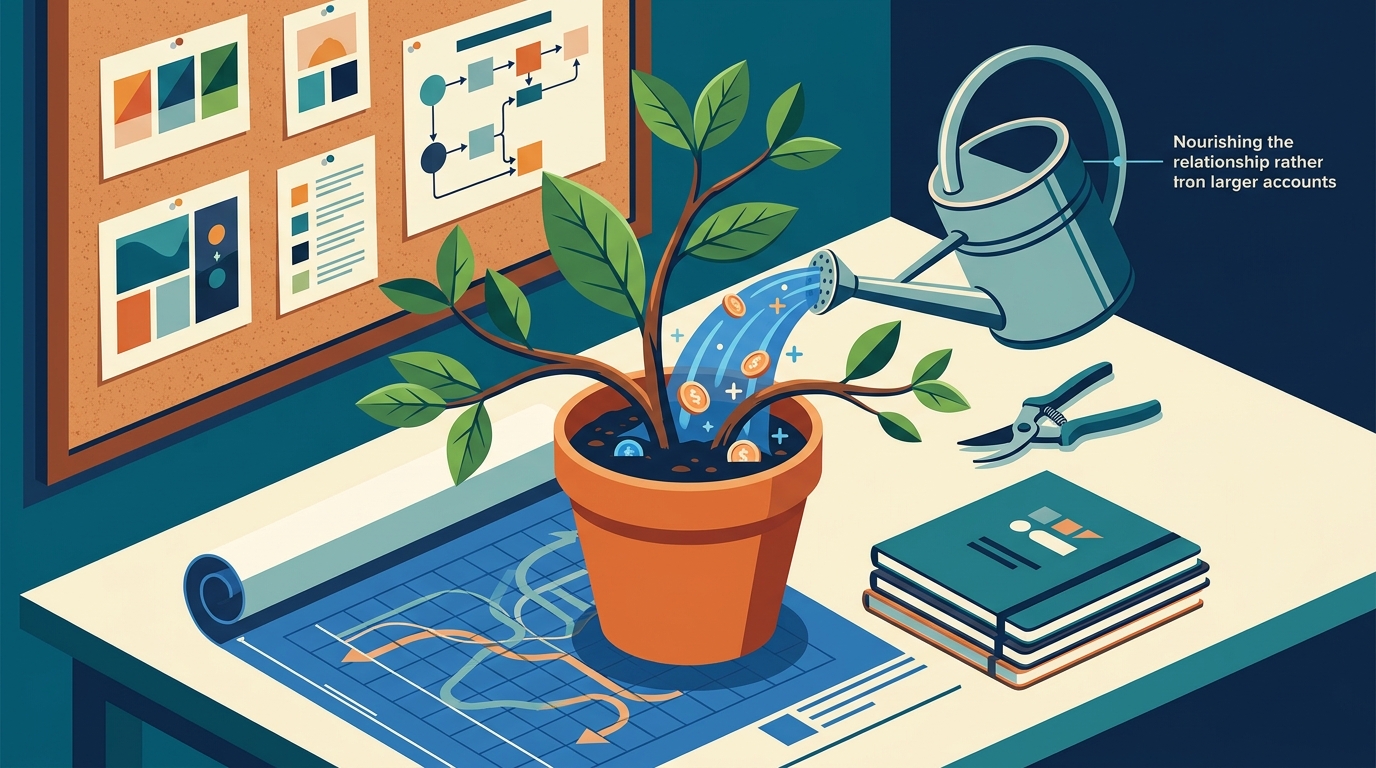
Client growth is the practice of expanding the scope, spend, and strategic depth of your relationships with current clients. It is one of the highest-ROI activities an agency can pursue because the trust and context are already in place.
According to Agency Management Institute, agencies that implement a structured client growth process see measurable results quickly. One agency reported that billings from existing clients grew by 17% and client satisfaction scores jumped by 23% within six months of rolling out a formal growth framework through AMI's Growing the Clients You Already Have workshop.
Empower Your Account Service Team
The biggest barrier to organic growth is that account executives often do not see client development as part of their role. They need a roadmap, measurable goals, and coaching. A good starting point is teaching AEs to prepare three to four probing questions before every client meeting that go beyond project updates and dig into the client's broader business challenges.
Set a 10% Growth Target Per AE
Give each account executive a clear goal to grow their book of business by at least 10% annually. Pair this with a reward system for delivering new revenue from existing clients. When the whole team is aligned, your agency transitions from vendor to strategic business partner.
Build Authority Through Thought Leadership
Thought leadership is the deliberate practice of sharing specialized expertise through content, speaking, and publishing to attract prospects who already view you as an expert. In 2026, agencies that prioritize proactive engagement see 25% higher retention rates according to industry analysis.
Drew McLellan and Stephen Woessner outline this approach in the book Sell with Authority, which argues that agencies competing on production alone are destined for a financial roller coaster. The alternative is to combine a narrow niche with a distinct point of view and share it consistently through cornerstone content like a podcast, column, or video series.
Invest 5 Hours a Week in Content
AMI's research with agencies suggests that dedicating roughly 10 to 20 hours per month to content creation can make an agency findable on search engines, more sought-after as conference speakers, and positioned to level up smaller clients into larger ones. That translates to about five hours a week, a modest investment for outsized returns. Listen to the Build a Better Agency podcast for weekly tactical advice on this approach.
Measure and Act on Client Satisfaction
A client satisfaction survey is a structured research tool used to collect quantitative and qualitative feedback from your clients about their experience with your agency. Done well, it doubles as a retention mechanism and a marketing opportunity.
Agencies with top-tier client satisfaction outpace competitors in growth by over 35% according to 2026 industry data from SmartMetrics. Yet many agencies skip this step or execute it poorly. AMI recommends using a third-party research partner for maximum candor, because clients will speak more freely when they are not talking directly to your team.
| Survey Approach | Candor Level | Cost | Marketing Value |
|---|---|---|---|
| Don't ask at all | None | $0 | None |
| Self-administered | Low to moderate | Low | Minimal |
| Third-party administered | High | Moderate | High |
The report-back step is where the real magic happens. When you share results with clients, including what needs fixing, you reinforce that you are open to continual improvement and remind them of capabilities they may not be using.
Systemize for Scalable Growth
Agency growth stalls when every team member has their own way of serving clients and there is no standardization. As discussed on the Build a Better Agency podcast with David Jenyns, once you get past about ten employees without documented systems, you hit a ceiling that blocks further scale.
The recommended approach follows three waves. First, systemize your Critical Client Flow, the core process by which your agency delivers work and earns revenue. Second, build finance and operations systems. Third, layer in growth-specific systems like business development pipelines and content workflows. Agencies that embrace this structured approach can scale without the chaos that typically accompanies rapid growth.
Specialize with a Niche Strategy
A niche strategy is the decision to focus your agency's expertise, messaging, and prospecting on a specific industry vertical or service category rather than trying to serve everyone. According to a 2026 Tapflare growth report, the fastest-growing independent agencies consistently leverage technology, focus on high-demand niches, and foster agile organizations.
Specialization lets you charge premium prices, shortens your sales cycle, and makes your content marketing dramatically more effective. If you are worried about feeling locked into a niche forever, that fear is unfounded. AMI has documented multiple agencies that successfully pivoted their niche and emerged stronger on the other side.
Track the Metrics That Matter
Growth without measurement is just guessing. AMI recommends every agency track AGI (Adjusted Gross Income) per FTE as a foundational metric. The target is $150,000 of AGI per full-time equivalent. AMI agencies average about $135,000, well above the industry norm of $100,000 to $110,000. If your ratio sits below that range, profitability is likely suffering.
The global marketing agency market reached an estimated $473.57 billion in 2026, growing at a 4.55% CAGR. Agencies that monitor their financial health weekly and monthly can double their bottom-line profit with just a few hours of focused attention, according to AMI's Running Your Agency for Growth, Profit and a Little Sanity workshop.
| Metric | Target | Industry Average | AMI Agency Average |
|---|---|---|---|
| AGI per FTE | $150,000 | $100,000 - $110,000 | ~$135,000 |
| Revenue from existing clients | 60 - 70% | Below 50% (most agencies) | Closer to target |
| Net profit margin | 15 - 30% | Varies widely | 15 - 30% (best practices) |
Key Takeaways
- Sixty to seventy percent of net new revenue should come from growing existing client relationships, not just chasing new logos.
- Equip your account service team with growth goals, probing questions, and reward systems to make organic expansion part of daily work.
- Establish thought leadership through consistent, niche-focused content to attract prospects who already trust your expertise.
- Use third-party client satisfaction surveys to get candid feedback and turn the results into a marketing and retention tool.
- Systemize your workflows in three waves: client delivery, finance and operations, and then growth processes.
- Track AGI per FTE and aim for at least $135,000 as a near-term benchmark, with $150,000 as the gold standard.
- Do not fear niching down; specialization shortens sales cycles, increases pricing power, and can always be adjusted later.
Frequently Asked Questions
What percentage of agency revenue should come from existing clients?
Industry best practice suggests that 60 to 70% of your net new revenue each year should come from clients you already serve. Most agencies fall short of this target, which is why structured client growth programs are so valuable.
How do I get my account executives to focus on client growth?
Start by making it explicit that growing their book of business is part of their role. Set a 10% annual growth target per AE, provide coaching on asking strategic questions, and build a reward system tied to new revenue from existing accounts.
What is AGI per FTE and why does it matter?
AGI per FTE stands for Adjusted Gross Income per Full-Time Equivalent. It measures how much revenue each employee generates after subtracting direct costs. The target is $150,000; agencies below $110,000 typically struggle with profitability.
How often should I run client satisfaction surveys?
There is no one-size-fits-all cadence, but AMI recommends conducting structured surveys at least annually. The depth of questions, the nature of your client engagements, and whether you use qualitative interviews alongside quantitative surveys will determine the ideal frequency.
Does niching down mean I have to turn away clients outside my niche?
Not necessarily. A niche strategy focuses your marketing and prospecting efforts. You can still accept work outside your specialty, but your content, speaking, and outreach should target the vertical where you have the deepest expertise.
How much time should my agency spend on thought leadership content?
Roughly five hours per week, or 10 to 20 hours per month, is enough to produce a podcast, blog, or video series that positions your agency as a recognized authority. The key is consistency over volume.
What is the first system I should build when scaling my agency?
Start with your Critical Client Flow, the end-to-end process by which work enters your agency, gets produced, and is delivered to the client. Systemizing this first removes person dependency and creates the foundation for all other growth systems.
Your Next Step
If you are ready to stop leaving revenue on the table with your existing clients, explore AMI's upcoming workshop calendar and register for the Growing the Clients You Already Have workshop. It is a two-day, hands-on experience that gives your team a step-by-step blueprint for building client growth into the daily fabric of your agency. No one has ever asked for a refund.