

How Small to Mid-Sized Marketing Agencies Can Improve Client Satisfaction Through Peer Networks
Running a small to mid-sized marketing agency can feel isolating. You juggle client expectations, staffing challenges, and financial pressures, often without an outside sounding board. A peer network is a structured group of non-competing agency owners who meet regularly to share challenges, strategies, and best practices. When used intentionally, these networks become a powerful engine for improving how you serve clients. Below, we break down exactly how peer networks drive measurable gains in client satisfaction and why agencies that invest in them consistently outperform those that go it alone.
Why Client Satisfaction Is the Metric That Matters Most
Creativity and campaign results grab headlines, but client happiness is what keeps agencies in business. As Workamajig notes, agencies are essentially in the business of customer service, and the happiness of your clients is often the one metric that defines your success. A satisfied client stays longer, spends more, and refers peers.
Yet many agencies avoid proactively measuring satisfaction. They assume everything is fine because a client hasn't left. That assumption is dangerous. Without structured feedback loops and external insight, you may miss warning signs until it is too late.
What Are Agency Peer Networks?
An agency peer network is a facilitated group of owners from non-competing markets who meet on a regular cadence to openly discuss financials, operations, and client strategy. At Agency Management Institute (AMI), peer networks are the cornerstone of everything they do. Each network includes a mix of advertising agencies, PR firms, marketing shops, and design firms committed to growing their businesses.
To protect candor, only one company from any specific geographic market or niche specialty is admitted to a network. This confidential environment promotes a dialogue of trust and sharing, allowing members to exchange real numbers and real challenges without competitive risk.
Live vs. Virtual Formats
AMI offers both live owner peer groups that meet twice a year for intensive two-day sessions and virtual owner peer groups that connect monthly for 90-minute sessions. Both formats deliver accountability, but they serve different time and travel preferences.
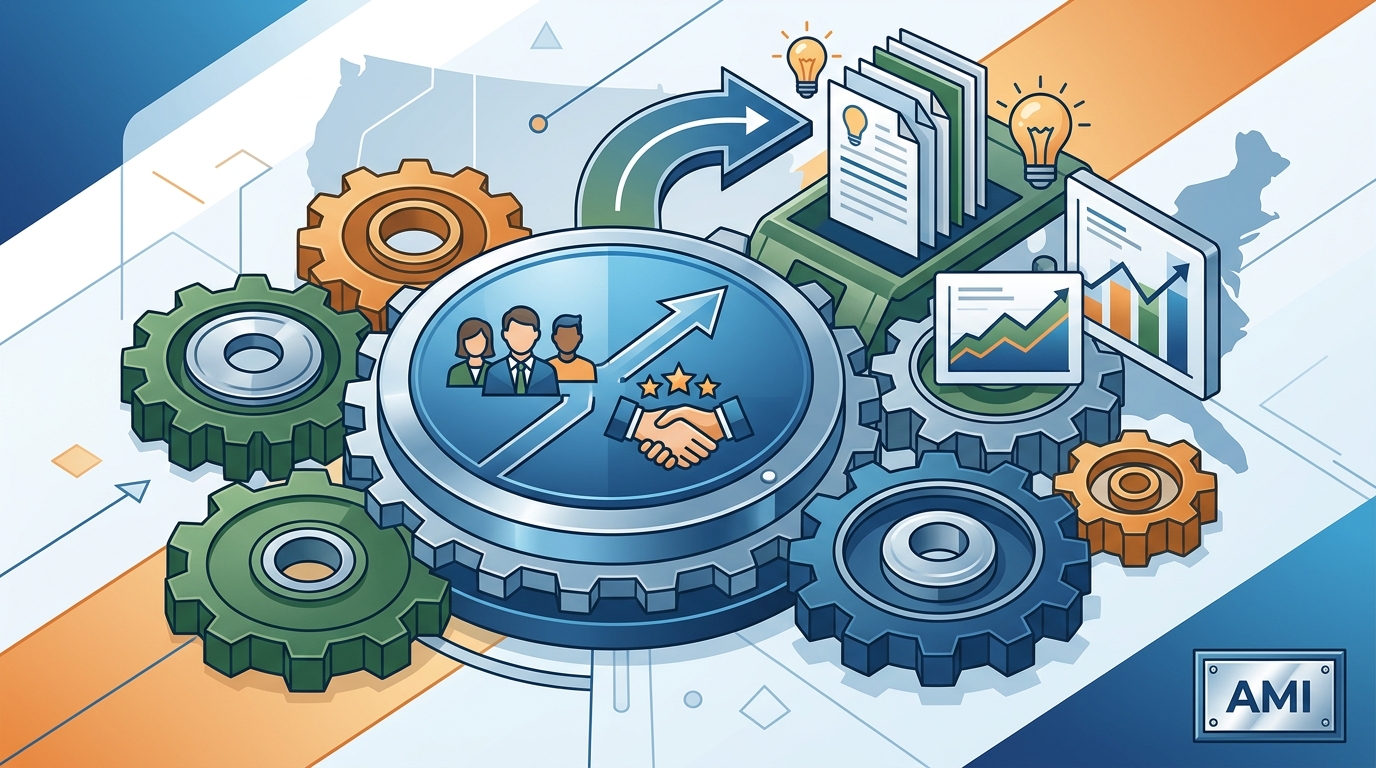
Gain an Outside Perspective on Client Challenges
One of the biggest benefits of a peer network is escaping what AMI founder Drew McLellan calls being "inside the same bottle." When every decision-maker sits within your agency, you lose objectivity. Peer networks give you that outside perspective from someone who walks in your shoes every day.
Imagine you are struggling with a client who constantly changes project scope. A peer who solved the same problem last quarter can share the exact contract language, communication cadence, or expectation-setting framework that worked. You skip months of trial and error.
Real Financial Transparency
One of the most insightful aspects of each meeting is that every agency shares its financials with the group. Seeing how other agencies price, staff, and structure client engagements lets you benchmark your own approach against proven models, directly improving the value you deliver to clients.
Share Best Practices That Directly Impact Clients
Peer networks are not just about commiserating. AMI groups actively share best practices in new business development, financial and marketing strategies, systems development, and organizational staffing strategies. These operational improvements cascade down to clients as faster turnarounds, tighter project management, and more strategic thinking.
Client engagement strategy is a term describing the deliberate plan an agency uses to build trust, communicate progress, and retain clients over time. Agencies that refine this strategy through peer input consistently see better retention and more referrals.
Use Peer-Informed Client Satisfaction Surveys
A client satisfaction survey is a structured research tool that collects honest feedback from your client base about service quality, communication, and results. AMI offers dedicated client satisfaction surveys designed specifically for agencies, and peer network members regularly discuss how to act on survey findings.
Key principles learned through AMI's survey work include using a third party to administer the survey so clients feel comfortable being candid, and always reporting findings back to clients with a clear action plan. When you tell clients what you learned and how you will improve, you reassure them that you are committed to continual improvement.
Why Third-Party Administration Matters
As AMI's client satisfaction research emphasizes, clients like you and won't be as candid as you want them to be when you self-administer. Third-party research is an investment in protecting your client base and improving your win/keep ratios.
Develop Stronger Leadership Across Your Team
Client satisfaction is not solely an owner's job. AMI recognized this when members asked for a peer group for their right-hand leaders, resulting in Key Leadership Groups that meet twice a year. When your senior team thinks and acts more like owners, client relationships strengthen at every touchpoint.
Investing in leadership development signals to clients that your agency is stable, forward-thinking, and committed to excellence. It also reduces the risk of key-person dependency, which is a common source of client anxiety in smaller agencies.
Peer Network Formats Compared
| Feature | Live Owner Peer Group | Virtual Owner Peer Group | Key Leadership Group |
|---|---|---|---|
| Meeting Cadence | Twice per year, 2+ days each | Monthly, 90 minutes | Twice per year, 2 days each |
| Ideal For | Deep-dive strategy and financials | Owners with limited travel flexibility | COOs, directors, senior leaders |
| Group Size | Small, curated (non-competing markets) | Up to 10 agencies | Small, curated |
| Client Satisfaction Impact | High: benchmarking, process overhaul | Moderate-High: ongoing accountability | High: improves day-to-day client delivery |
| Location | Denver or rotating destinations | Zoom | Denver |
Key Takeaways
- Client satisfaction is the single most important driver of agency retention and growth.
- Peer networks break the isolation of agency ownership by providing objective, experienced perspectives.
- Sharing financials openly with non-competing peers helps you benchmark pricing, staffing, and service delivery.
- Third-party client satisfaction surveys yield far more candid and actionable feedback than self-administered ones.
- Reporting survey results back to clients with a clear improvement plan builds deep trust and loyalty.
- Investing in leadership development for your senior team improves client experience at every touchpoint.
- Both live and virtual peer network formats deliver value; choose based on your schedule and learning style.
Frequently Asked Questions
What is a peer network for marketing agencies?
A peer network is a facilitated group of agency owners from non-competing markets who meet regularly to share challenges, strategies, and financials in a confidential setting.
How do peer networks improve client satisfaction?
Members gain outside perspectives on client problems, learn proven processes from peers, and benchmark their service delivery against other successful agencies. These insights translate into better communication, faster problem resolution, and stronger client relationships.
Are peer network discussions truly confidential?
Yes. Reputable programs like AMI admit only one agency per geographic market or specialty niche, and the confidential environment promotes a dialogue of trust and sharing among members.
What is a client satisfaction survey?
A client satisfaction survey is a structured tool, ideally administered by a third party, that gathers honest feedback from your clients on service quality, communication, and outcomes so you can make data-driven improvements.
How often should agencies survey their clients?
Best practice is to conduct a comprehensive survey at least once per year. You can supplement it with brief post-project check-ins each quarter to stay ahead of issues.
Can virtual peer groups deliver the same value as in-person groups?
Virtual groups offer high-frequency touchpoints with minimal time disruption. AMI's virtual groups meet monthly for 90 minutes, providing consistent accountability. Live groups offer deeper immersion. Many agency owners find value in both formats.
How long do agencies typically stay in a peer network?
At AMI, many network members have been part of the community for over 20 years, a strong indicator that the ongoing value justifies the investment.
Do peer networks help with more than client satisfaction?
Absolutely. Peer networks address profitability, staffing, new business development, succession planning, and leadership growth. AMI also offers a comprehensive succession planning program and additional resources for members.
Take the First Step Toward Happier Clients
If you are ready to stop guessing what your clients think and start building the systems that keep them loyal, explore AMI's peer network options. Whether you prefer live owner peer groups or virtual peer groups, you will gain a trusted circle of peers who help you serve clients better every single day. Learn more about AMI membership and apply today.