

How Small to Mid-Sized Marketing Agencies Improve Client Satisfaction Through Peer Networks
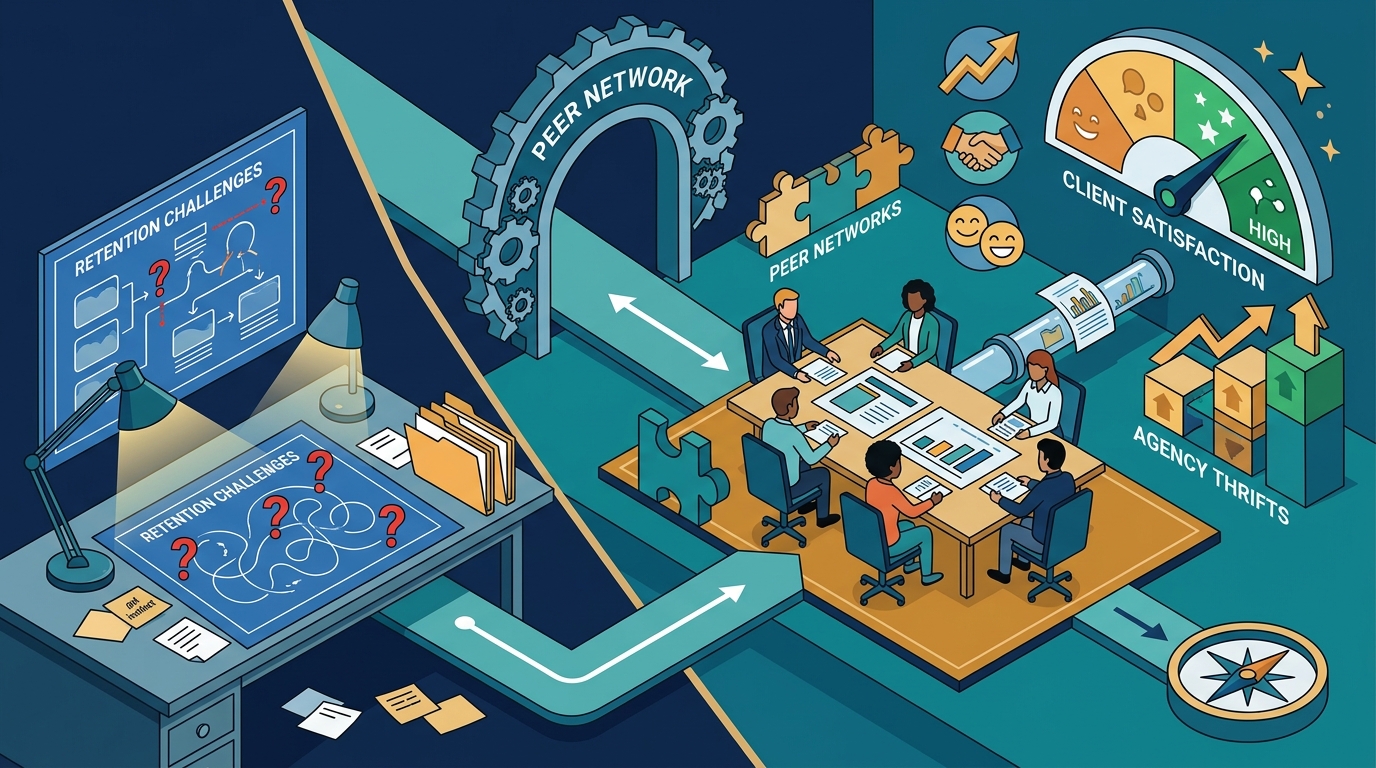
Client satisfaction is the single biggest predictor of whether a marketing agency thrives or stalls. Yet most small to mid-sized agency owners try to solve retention challenges alone, relying on gut instinct instead of proven frameworks. A peer network is a structured group of non-competing agency owners who meet regularly to share strategies, financials, and hard-won lessons. When agencies plug into these networks, they gain outside perspective that translates directly into better client outcomes, stronger retention rates, and higher profitability. Here is a step-by-step look at how peer networks drive measurable improvements in client satisfaction.
Why Client Satisfaction Matters More Than Acquisition
Acquiring new clients can cost up to seven times more than retaining an existing one. Research from Bain & Company shows that increasing client retention by just 5% can boost profits by 25% to 95%. For smaller agencies, where a single client departure can represent 15-30% of revenue, satisfaction is not a nice-to-have; it is a survival metric.
Despite this, only 30% of agencies focus equally on retention and acquisition, according to industry research from Ravetree. Peer networks help close that gap by giving owners a structured forum for improving how they serve existing clients.
What Are Agency Peer Networks?
An agency peer network is a curated group of non-competing agency owners who meet on a regular cadence to share challenges, strategies, and financial benchmarks. At AMI's owner peer networks, each group includes a mix of advertising agencies, PR firms, marketing shops, and design firms, and only one company from any specific geographic market or niche specialty is admitted.
AMI offers both virtual peer groups that meet monthly for 90 minutes and live owner peer groups that meet twice a year for intensive two-day sessions. Many members have participated for over 20 years, which speaks to the lasting value these groups deliver.
Step 1: Gain Outside Perspective on Client Relationships
Agency owners often operate in a silo. As AMI founder Drew McLellan puts it, you cannot objectively see the outside of the bottle from inside. Peer networks break that isolation by connecting you with people who walk in your shoes every day but bring fresh, unbiased viewpoints.
How This Improves Client Satisfaction
When you describe a difficult client scenario to a peer group, you receive multiple tested solutions rather than guessing. A peer who solved a similar retention problem at their shop can share exactly what worked, saving you months of trial and error.
Confidential, Trust-Based Environment
Effective peer networks thrive on candor. AMI's groups promote a confidential environment where the key to making the network meaningful is members' willingness to be open and honest, sharing successes as well as failures.
Step 2: Benchmark Your Performance Against Peers
One of the most powerful features of a peer network is financial and operational benchmarking. At every AMI meeting, each agency shares its financials with the group. This transparency helps owners understand where they over-invest, under-deliver, or miss opportunities to improve the client experience.
| Metric | Solo Agency Owner | Peer Network Member |
|---|---|---|
| Access to comparative financial data | Limited to public benchmarks | Real-time peer financials shared each meeting |
| Client satisfaction measurement | Ad hoc or self-administered surveys | Third-party survey best practices from peers |
| Average time to solve retention issues | Months of experimentation | Weeks, leveraging peer-tested strategies |
| Ongoing accountability | Self-directed only | Structured group check-ins |
Benchmarking is the practice of comparing your agency's key performance indicators against those of similar firms to identify gaps and opportunities. With peer data in hand, you can make smarter decisions about staffing, pricing, and service delivery that directly affect client happiness.
Step 3: Implement Third-Party Client Satisfaction Surveys
A client satisfaction survey is a structured research tool used to measure how well your agency meets client expectations. Many agencies skip surveys because they fear negative feedback or assume that client retention equals satisfaction. Both assumptions can lead to missed opportunities or impending disasters.
Why Third-Party Administration Matters
According to AMI's research, you get much richer, more candid answers when you do not self-administer the survey. Clients hold back honest feedback when speaking directly to their agency. AMI offers third-party client satisfaction surveys that help agencies uncover blind spots and protect their client base.
Report Back to Build Trust
The real marketing value of a survey comes in the report-back phase. When you tell clients what you learned and how you plan to address it, you reassure them that your agency is committed to continual improvement. This transparency often strengthens the relationship more than the survey data itself.
Step 4: Develop Leaders Who Deliver Better Client Experiences
Client satisfaction does not live in a single department. It flows from leadership. AMI's Key Leadership Groups meet twice a year so that agency second-in-commands learn to think and behave more like owners, raising service quality across the entire organization.
Investing in workshops and bootcamps for account executives also pays dividends. When AEs understand profitability, negotiate scope effectively, and proactively identify upsell opportunities, clients experience a more strategic partnership rather than reactive order-taking.
Step 5: Build Accountability Into Your Retention Strategy
Good intentions fade without accountability. Peer networks create a built-in accountability loop. Every meeting, you report progress on goals you set at the prior session. Your peers celebrate wins, call out stalls, and push you to follow through on the client satisfaction improvements you committed to.
This rhythm of commitment, action, and review is what separates agencies that talk about improving client satisfaction from those that actually do it. AMI members often describe their peer group as an unofficial board of directors that keeps them honest and moving forward.
Key Takeaways
- Improving client retention by just 5% can boost agency profits by 25% to 95%, making satisfaction a top financial priority.
- A peer network gives you outside perspective from non-competing agency owners who understand your challenges firsthand.
- Sharing financials and benchmarks with peers reveals blind spots that hurt client satisfaction.
- Third-party client satisfaction surveys produce more candid feedback than self-administered ones.
- Reporting survey results back to clients builds trust and often strengthens the relationship.
- Developing key leaders through peer groups and workshops raises service quality agency-wide.
- Built-in accountability in peer networks ensures client satisfaction improvements actually get implemented.
Frequently Asked Questions
What is a peer network for agency owners?
A peer network is a structured group of non-competing agency owners who meet regularly to share strategies, financial data, and practical advice. AMI offers both virtual and live peer group formats for agency owners, COOs, CFOs, and key leaders.
How do peer networks improve client satisfaction?
Peer networks provide outside perspective, proven retention strategies from other agencies, and a built-in accountability system. Members learn what works across hundreds of agencies rather than relying on isolated guesswork.
What is a client satisfaction survey?
A client satisfaction survey is a research instrument designed to gauge how well an agency meets client expectations. When administered by a third party, it yields more candid and actionable feedback.
Why should agencies use third-party surveys instead of DIY?
Clients tend to be less candid when providing feedback directly to their agency. A third-party administrator creates psychological safety, resulting in richer insights that help agencies improve.
How often do AMI peer groups meet?
AMI virtual owner peer groups meet monthly for 90 minutes. Live owner peer groups meet twice a year for intensive two-day sessions, typically in Denver or member-chosen destinations.
Can peer networks help with agency profitability too?
Yes. Financial benchmarking is a core activity in every peer network meeting. Members share real numbers, identify profit leaks, and implement pricing and staffing strategies that increase both AGI and client value delivery.
Who qualifies for an AMI peer network?
AMI peer networks are designed for small to mid-sized agency owners across advertising, PR, marketing, digital, and design. Only one agency per geographic market or niche specialty is admitted to each group to ensure open, non-competitive collaboration.
Get Started With a Peer Network Today
If you are ready to stop solving client satisfaction challenges alone, explore AMI membership options and find the peer group format that fits your schedule and goals. Join a community of agency owners who have been improving their businesses together for over two decades.