

Client satisfaction is the single biggest predictor of whether a marketing agency grows or stalls. Yet many small to mid-sized agency owners try to solve retention challenges alone, without outside perspective. A peer network is a structured group of non-competing agency owners who meet regularly to share financials, swap strategies, and hold each other accountable. When used intentionally, peer networks give you battle-tested playbooks for keeping clients happy, increasing retention rates, and growing your adjusted gross income. Below, we break down exactly how to leverage peer networks to transform your client satisfaction scores.
Why Client Satisfaction Is a Growth Lever
Retention is where profitable agencies separate themselves from the pack. According to a 2025 benchmark study of 300+ agencies, eight-figure agencies retain 92% of clients annually compared to just 78% for seven-figure shops. That 14-point gap translates directly into revenue stability and profit margins.
Client acquisition costs 4 to 10 times more than retention. Existing clients also spend 67% more on average than new ones, according to recent industry data. When satisfaction dips, agencies get trapped on what some call the "acquisition hamster wheel," constantly chasing new business to replace departing clients.
What Are Agency Peer Networks?
An agency peer network is a confidential group of non-competing agency owners who meet on a regular cadence to share challenges, financials, and proven strategies. At Agency Management Institute, peer networks are the cornerstone of AMI's membership model. Each network includes a mix of advertising agencies, PR firms, digital shops, and design firms, and only one company from any specific geographic market is admitted.
AMI offers both virtual peer groups that meet monthly for 90 minutes and live owner peer groups that gather for 2.5 days of intensive learning twice a year. The key to making a peer network meaningful is members' willingness to be open and honest, sharing successes as well as failures.
5 Ways Peer Networks Improve Client Satisfaction
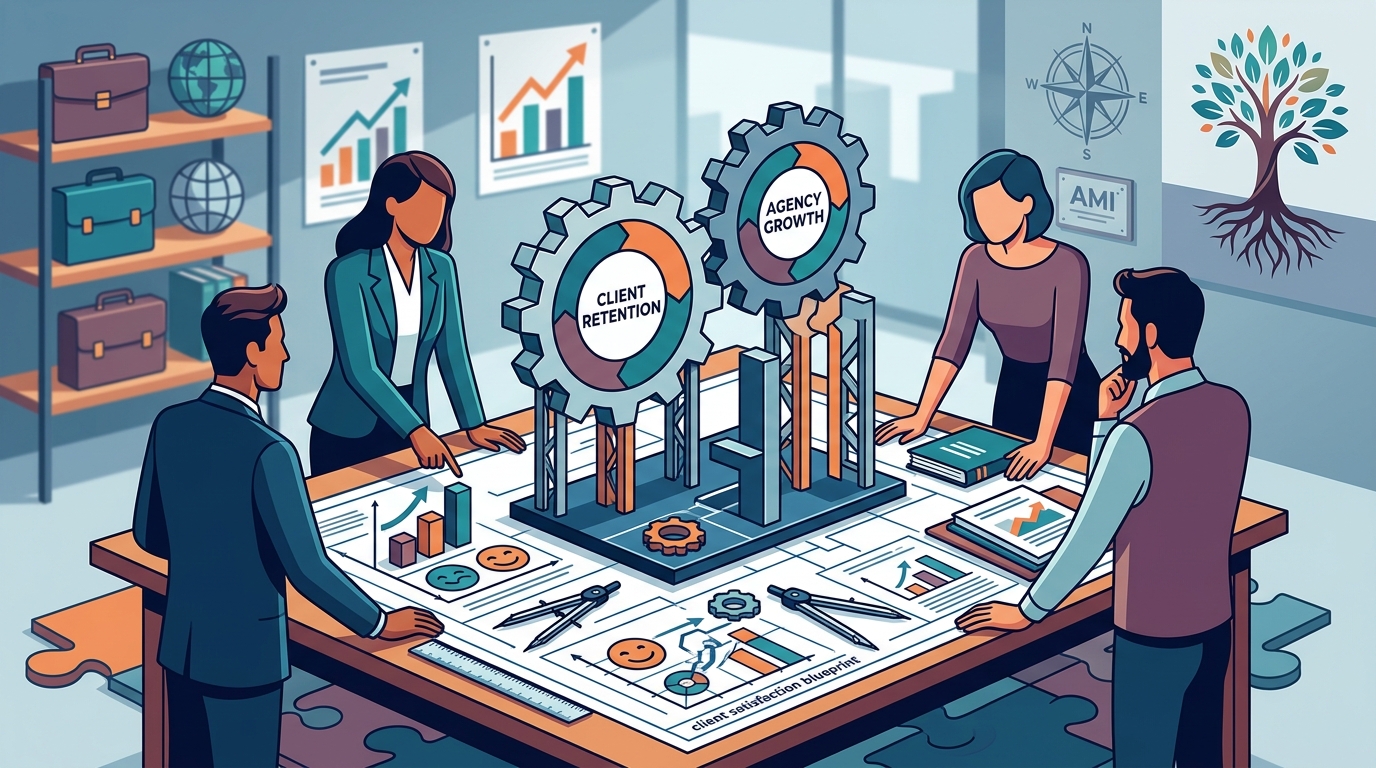
1. Outside Perspective on Client Relationships
Agency owners often operate inside their own "bottle," unable to see their blind spots. Peer networks provide that outside perspective from people who walk in your shoes every day. When a fellow owner shares how they resolved a difficult client situation, you gain a playbook you would never develop in isolation.
2. Shared Financial Transparency
One of the most insightful aspects of AMI peer network meetings is that every agency shares its financials with the group. This transparency reveals whether you are underpricing services, over-servicing accounts, or misallocating resources in ways that erode client experience. Your peers contribute valuable information and strategies you can use to grow your business.
3. Accountability for Action
A peer group functions as an unofficial board of directors. Members hold each other accountable for implementing improvements discussed in meetings. When you commit to launching a client feedback loop or restructuring your account management process, your peers follow up at the next session.
| Satisfaction Driver | Without Peer Network | With Peer Network |
|---|---|---|
| Client feedback frequency | Ad hoc or annual | Structured quarterly process |
| Pricing confidence | Guesswork based on competitors | Benchmarked against 10+ agencies |
| Account management training | Baptism by fire | Shared best practices and workshops |
| Problem resolution speed | Trial and error | Peer-tested solutions on demand |
| Retention rate (typical) | 78% annual | 90%+ annual |
4. Access to Proven Client Retention Strategies
Rather than reinventing the wheel, peer network members learn from agencies that have already solved common problems. According to AgencyAnalytics research, clear communication and transparency are the top strategies for retaining clients. Peers share exactly how they structure client reporting, quarterly business reviews, and proactive check-ins.
5. Leadership Development That Cascades to Clients
AMI also offers Key Leadership Groups for agency second-in-commands. When your right-hand leader thinks and behaves more like an owner, client relationships benefit at every touchpoint. Agencies that invest more in training achieve higher retention, with top-performing shops spending $7,500 per employee annually on development.
Using Client Satisfaction Surveys Effectively
Peer networks consistently reinforce one lesson: you must ask your clients how they feel about the relationship. A client satisfaction survey is a structured research tool that measures how well your agency meets client expectations across service delivery, communication, and strategic value. AMI offers dedicated client satisfaction survey services built specifically for agencies.
The most important rule? Do not self-administer the survey. Your clients will not be as candid with you as they will with a third party. When you report results back to clients, including what needs improvement, you demonstrate a commitment to continuous growth that strengthens loyalty.
As AMI's Drew McLellan has noted, agencies tend to avoid satisfaction surveys either because they fear negative feedback or they assume everything is fine because clients have not left yet. Both assumptions can lead to missing an impending disaster. Third-party research is an investment in protecting your client base.
Key Benchmarks: Retention and Satisfaction Data
Understanding where your agency stands requires benchmarks. Here is how retention data breaks down across the industry:
| Agency Type | Annual Retention Rate | Avg. Client Lifespan |
|---|---|---|
| 8-figure agencies | 92% | 5+ years |
| 7-figure agencies | 78% | 2-3 years |
| Retainer-based model | 82% | 4.7 years |
| Project-based model | 58% | 2 years |
| Full-service agencies | 75% | 3-4 years |
A 5% increase in client retention can boost profits by 25% to 95%. If your agency currently sits below the 80% mark, peer network participation combined with formal satisfaction surveys can close that gap significantly.
How to Get Started with a Peer Network
Getting started is simpler than most owners expect. Here is a practical path:
- Assess your readiness. Be willing to share financials, failures, and strategies openly. Peer networks only work when members commit to transparency.
- Choose the right format. If travel is a barrier, AMI's virtual owner peer groups offer monthly 90-minute sessions. For deeper immersion, live groups meet twice yearly for multi-day sessions.
- Apply for membership. AMI limits each network to one agency per geographic market, so there is no competitive threat. Visit the AMI membership page to explore options.
- Implement a client satisfaction survey. Use findings from your first peer meetings to design a third-party survey that captures honest client feedback.
- Track and report progress. Share results at your next peer meeting and refine your approach based on collective input.
Key Takeaways
- Peer networks give agency owners outside perspective from people who face the same challenges without competing in the same market.
- Agencies with higher retention rates are significantly more profitable, with 8-figure agencies retaining 92% of clients versus 78% at the 7-figure level.
- Sharing financials within a peer group reveals pricing and resourcing blind spots that directly affect client satisfaction.
- Third-party client satisfaction surveys produce more candid feedback than self-administered surveys.
- Clear communication and transparency are the top retention strategies identified by agency benchmark research.
- AMI peer networks have retained members for 15 to 20+ years, demonstrating lasting value for agency owners.
- A 5% improvement in retention can increase profits by 25% to 95%, making peer-driven improvements highly leveraged investments.
Frequently Asked Questions
What is an agency peer network?
An agency peer network is a structured group of non-competing agency owners who meet regularly to share challenges, strategies, and financial data in a confidential setting. AMI's peer networks include a mix of ad agencies, PR firms, digital shops, and marketing agencies.
How do peer networks improve client satisfaction?
Peer networks expose agency owners to proven retention tactics, financial benchmarks, and outside perspectives on client management. Members implement strategies learned from peers who have already solved similar client relationship challenges.
What is a client satisfaction survey?
A client satisfaction survey is a formal research instrument used to measure how well an agency meets its clients' expectations across areas like communication, strategy, and service delivery. AMI recommends using a third party to administer these surveys for more candid results.
How often should agencies survey their clients?
Best practice is to conduct a comprehensive satisfaction survey annually, supplemented by brief project-based feedback after major deliverables. Some agencies also schedule informal check-in conversations once or twice a year.
What is a good client retention rate for a marketing agency?
Top-performing agencies maintain annual retention rates above 90%. The average across mid-sized agencies sits around 78% to 84%, which means those agencies must generate 16% or more in new business annually just to break even.
Are AMI peer networks virtual or in-person?
AMI offers both formats. Virtual peer groups meet monthly for 90 minutes via video. Live owner peer groups meet twice a year for two or more days of intensive, in-person collaboration, typically in Denver, CO.
How much does it cost to join an AMI peer network?
AMI offers several membership tiers, from associate memberships without a peer group to full peer network memberships. Visit the AMI membership page for current pricing and benefits, including workshop discounts, salary surveys, and group health plans.
Can my agency's leadership team also join a peer group?
Yes. AMI created Key Leadership Groups specifically for agency second-in-commands. These groups meet twice a year in person, helping your right-hand leader develop an ownership mindset that improves client relationships across the board.
Take the Next Step for Your Agency
If you are ready to stop solving client satisfaction challenges alone, explore AMI's peer network membership options and connect with a community of agency owners committed to growth. Your clients, and your bottom line, will thank you.