

How Small to Mid-Sized Marketing Agencies Can Improve Client Satisfaction Through Peer Networks
Running a small to mid-sized marketing agency can feel isolating. You juggle client expectations, staffing headaches, and financial pressures, often without anyone to bounce ideas off. A peer network is a structured group of non-competing agency owners who meet regularly to share challenges, strategies, and accountability. These networks do more than fight loneliness. They give you tested frameworks, fresh perspectives, and proven practices that translate directly into happier, longer-lasting client relationships. Here is how to harness peer networks to elevate client satisfaction at your agency.
Why Client Satisfaction Is the Growth Engine for Agencies
Client retention is far more cost-effective than acquisition. According to research highlighted by Bain & Company, increasing customer retention by just 5% can boost profits by 25% to 95%. For agencies, the stakes are even higher because a single client departure can represent 15 to 30% of annual revenue.
The average client-agency relationship lasts only about 3.2 years according to R3. Smaller agencies often see relationships end even sooner. Satisfaction surveys, proactive communication, and strategic improvements are the levers that extend those relationships and boost referrals.
What Are Agency Peer Networks?
A peer network is a curated group of non-competing agency owners who meet on a regular cadence to openly share financials, strategies, wins, and failures. The goal is mutual growth through candid collaboration. AMI's Live Owner Peer Groups are a prime example: each network includes a mix of advertising agencies, PR firms, marketing shops, and design firms, and only one agency per geographic market is admitted to eliminate competitive tension.
These groups function as an unofficial board of directors for agency owners. Many AMI members have participated for over 20 years, which speaks to the lasting value peer accountability provides.
How Peer Learning Translates to Better Client Outcomes
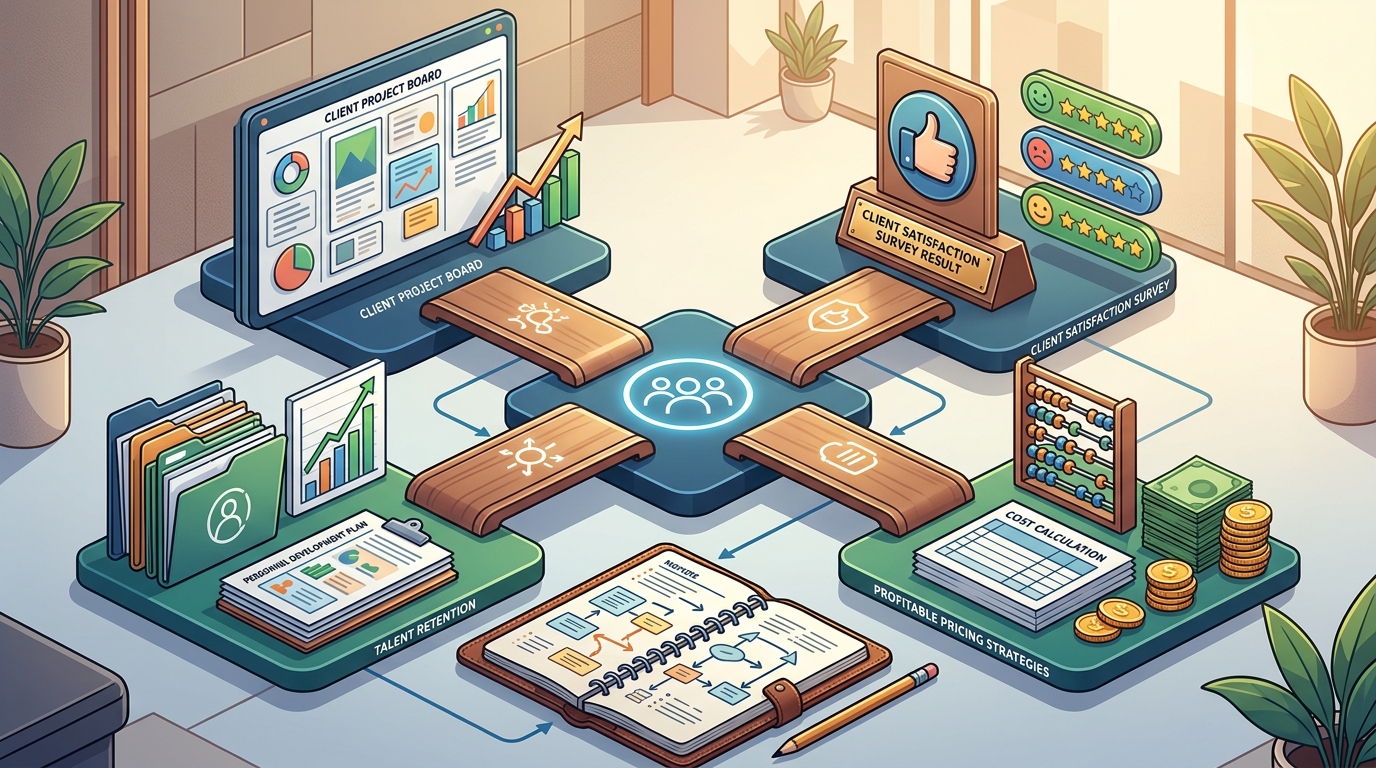
Gain Outside Perspective on Service Delivery
As AMI founder Drew McLellan often says, you cannot objectively see the outside of the bottle from inside it. A peer network gives you that outside perspective from people who walk in your shoes every day. When peers critique your onboarding process or creative workflow, you uncover blind spots your own team cannot see. Fixing those blind spots directly improves the client experience.
Adopt Proven Best Practices Faster
Peers contribute valuable information and strategies you can apply immediately. Instead of spending months testing a new client communication cadence or project management approach, you can learn from an agency that already refined it. AMI's membership program structures this sharing through facilitated meetings, so every conversation is focused on actionable takeaways.
Build Accountability for Improvement
A peer group creates gentle but consistent pressure to follow through. When you tell a room of fellow owners you will implement quarterly business reviews with every client, you are far more likely to actually do it. That accountability loop is the mechanism that turns good intentions into measurable client satisfaction gains.
Use Client Satisfaction Surveys to Close the Gap
A client satisfaction survey is a structured research tool that measures how clients perceive your agency's performance across key dimensions like communication, strategic value, and creative quality. AMI offers Client Satisfaction Surveys as a core service, and the methodology contains lessons every agency can learn from.
The most critical insight: you get much richer, more candid answers when a third party administers the survey rather than your own team. Clients like you and will soften their feedback when talking directly to you. Third-party research is an investment in protecting your client base and improving your win/keep ratios.
Peer networks amplify the value of surveys because you can benchmark your results against other agencies in your group. If your Net Promoter Score trails the group average, peers can help you diagnose the root cause and prioritize fixes.
Share Financial Benchmarks to Price and Staff Properly
One of the most insightful aspects of peer network meetings is that every agency shares its financials with the group. Underpricing and understaffing are two of the fastest paths to poor client outcomes, because burned-out teams deliver subpar work. When you see that peers with similar AGI are staffing at a ratio you have not considered, you gain the confidence to adjust.
AMI's Money Matters workshop teaches owners the key benchmarks for measuring successful performance. Combined with peer group financial sharing, this creates a feedback loop: learn the benchmarks, apply them, then pressure-test your results with peers each quarter.
Develop Your Leaders Through Peer Groups
Client satisfaction is not just the owner's responsibility. Account managers and key leaders are the primary client-facing members of your staff, and their skills directly determine the quality of every client relationship. AMI created AE Bootcamps and Key Leadership Groups specifically to address this gap.
Key Leadership Groups meet twice a year in person and let your right-hand leaders learn from their peers and AMI's agency owner facilitators. When leaders think and behave more like owners, they make better decisions on scope, communication, and problem resolution, all of which feed directly into client satisfaction scores.
Peer Network Formats Compared
| Format | Cadence | Best For | Client Satisfaction Impact |
|---|---|---|---|
| Live Owner Peer Groups | Twice a year, 2 days each | Deep strategic discussions, financial sharing | High: immersive, relationship-driven accountability |
| Virtual Owner Peer Groups | Monthly, 90 minutes | Ongoing tactical problem solving | Medium-High: frequent touchpoints keep momentum |
| Key Leadership Groups | Twice a year in Denver | Developing client-facing leaders | High: directly improves frontline service quality |
| Virtual COO/CFO Groups | Monthly or quarterly | Operational and financial optimization | Medium: indirect impact through better resourcing |
| Associate Membership (no peer group) | Ongoing access | Resources, discounts, webinars | Low-Medium: self-directed learning only |
Key Takeaways
- Peer networks give agency owners outside perspective from non-competing peers who understand the unique pressures of agency life.
- Client satisfaction surveys administered by a third party yield the most candid, actionable feedback from clients.
- Sharing financials with peers helps you benchmark pricing and staffing to avoid burnout-driven service failures.
- Leadership development through peer groups directly improves the quality of client-facing interactions.
- Increasing client retention by just 5% can increase profits by 25% to 95%, making satisfaction a top financial priority.
- AMI peer network members often stay for 20+ years, demonstrating the sustained value of structured peer learning.
- Combining surveys, peer accountability, and leadership training creates a compounding improvement loop for client satisfaction.
Frequently Asked Questions
What is a peer network for marketing agencies?
A peer network is a facilitated group of non-competing agency owners who meet regularly to share challenges, financials, and best practices. AMI's owner peer networks are considered the cornerstone of their membership offerings.
How do peer networks improve client satisfaction?
Peer networks expose blind spots in your service delivery, provide tested strategies from other agencies, and create accountability to implement improvements. These factors combine to produce better client experiences and stronger retention.
How often do AMI peer groups meet?
Live owner groups meet twice a year for two full days. Virtual owner groups meet monthly for 90 minutes. Key Leadership Groups meet twice a year in Denver.
Can virtual peer groups be as effective as in-person ones?
Virtual groups offer more frequent touchpoints with less time and travel commitment. They are especially valuable for agencies that want ongoing tactical support between deeper in-person sessions.
Why should agencies use third-party client satisfaction surveys?
Clients tend to soften their feedback when speaking directly to their agency. A third-party surveyor creates the confidential environment needed for truly candid responses, which leads to more actionable insights.
What financial benchmarks should agencies track?
Key benchmarks include adjusted gross income (AGI), profit margins, staff-to-revenue ratios, and client concentration percentages. AMI's Money Matters workshop teaches owners how to use these numbers to improve performance.
How long do agencies typically stay in AMI peer networks?
Many AMI network members have been part of their peer group for over 20 years. Long tenure reflects the ongoing value these groups provide as agencies evolve through different growth stages.
What is the cost of losing a client for a small agency?
For small to mid-sized agencies, losing a single client can mean 15 to 30% of annual revenue disappearing overnight. The ripple effects include lost referrals, reduced team morale, and reputation risk.
Take the Next Step for Your Agency
If you are ready to stop going it alone and start learning from peers who understand your world, explore AMI's membership options. Whether you choose a live or virtual peer group, you will gain the outside perspective, accountability, and proven frameworks needed to keep your clients happy and your agency growing.