

Running a small to mid-sized marketing agency can feel isolating. You juggle client expectations, team development, and financial targets with few people who truly understand your challenges. A peer network is a structured group of non-competing agency owners who meet regularly to share strategies, financials, and hard-won lessons. When leveraged intentionally, these networks become a powerful engine for improving how your agency serves and retains clients. Below, we break down exactly how peer networks translate into measurable gains in client satisfaction.
Why Client Satisfaction Is a Growth Lever
Client retention is not just a feel-good metric. According to research highlighted by Vendasta, acquiring new customers can be 5 to 20 times more expensive than retaining existing ones. For agencies where a single departure can represent 15 to 30 percent of revenue, satisfaction is survival.
Research from Bain & Company (via Outreach) shows that increasing client retention by just 5% can boost profits by 25% to 95%. Yet many agencies avoid systematically measuring client happiness. They assume that if a client is still around, everything is fine.
That assumption is dangerous. As AMI's Drew McLellan has noted, agencies tend to avoid client satisfaction surveys because they are either afraid to hear something negative or assume silence equals contentment. A peer network forces you to confront these blind spots.
What Are Agency Peer Networks?
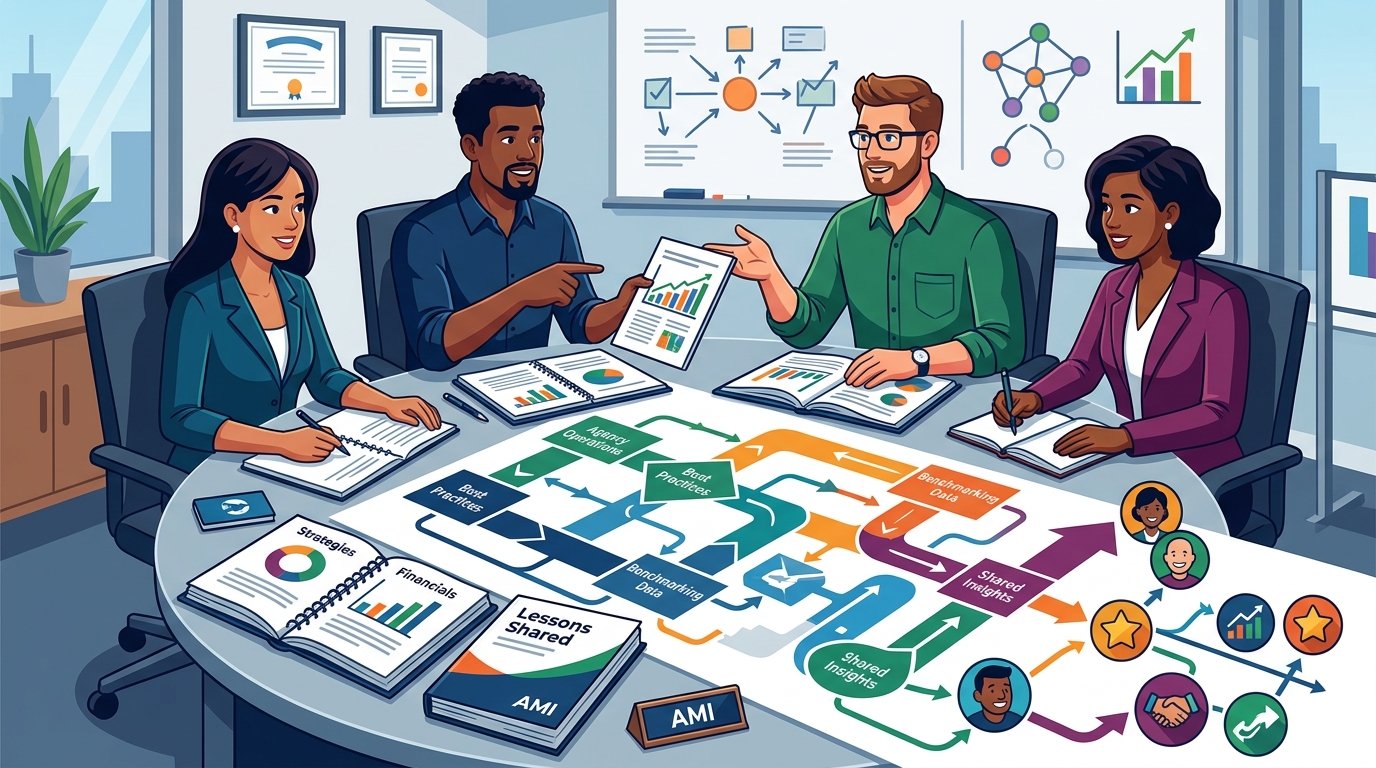
A peer network is a facilitated group of agency owners from non-competing markets who meet on a regular cadence to share financials, strategies, and operational challenges. The concept is built on confidentiality and mutual accountability.
At Agency Management Institute, peer networks are the cornerstone of the organization. Each network includes a mix of advertising agencies, PR firms, marketing shops, and design firms. Only one company from any specific geographic market or niche specialty is admitted, ensuring open collaboration without competitive risk.
Why the "Outside the Bottle" Perspective Matters
AMI uses a vivid analogy: you cannot objectively describe the outside of a bottle from inside it. Your partners share the same biases you do. Peer network members walk in your shoes every day but operate in entirely different markets, giving you a perspective you simply cannot generate internally.
Virtual vs. Live Formats
AMI offers both virtual owner peer groups that meet monthly for 90 minutes and live owner peer groups that gather twice a year for two full days. There are also specialized groups for COOs, CFOs, and key leaders.
How Peer Networks Directly Improve Client Satisfaction
Joining a peer network does not magically make clients happier. The value comes from specific behaviors the network encourages and enables.
1. Benchmarking Service Delivery
One of the most insightful aspects of each AMI meeting is that every agency shares its financials with the group. This transparency extends to service processes, staffing ratios, and client management workflows. When you learn that peer agencies handle onboarding or quarterly business reviews differently, you gain concrete ideas you can bring home and implement immediately.
2. Learning from Others' Client Failures
Peer networks thrive on honesty. Members share not only successes but also failures. When a fellow owner recounts how they lost a key account due to poor communication, you can audit your own practices before the same problem surfaces. This proactive approach is the difference between reactive damage control and a systematic satisfaction strategy.
3. Adopting Proven Retention Tactics
Strategies like third-party client satisfaction surveys, structured quarterly reviews, and proactive account growth plans often spread through peer networks. AMI itself offers client satisfaction survey services that many network members adopt after seeing peers report results.
Peer Network Formats Compared
| Feature | Virtual Peer Group | Live Peer Group | Key Leadership Group |
|---|---|---|---|
| Meeting Cadence | Monthly, 90 minutes | Twice yearly, 2 days each | Twice yearly, 2 days (Denver) |
| Ideal For | Owners with limited travel budgets | Owners wanting deep, immersive sessions | Senior leaders (COOs, directors) |
| Financial Sharing | Yes | Yes | Yes |
| Non-Compete Protection | One per market | One per market | One per market |
| Facilitated By | AMI team | AMI team (Drew McLellan) | AMI agency owner facilitators |
Each format delivers the core benefit of outside perspective and accountability. The right choice depends on your schedule, budget, and whether you want to extend the experience to your leadership team through AMI's membership options.
Building a Client Feedback Loop with Peer Insights
Client satisfaction is a measurement discipline, not a gut feeling. A client satisfaction survey is a structured research instrument used to capture how clients perceive the quality, communication, and value of your agency's work. Done well, it doubles as a marketing tool.
AMI recommends that agencies avoid self-administering surveys because clients will not be as candid when responding directly to someone they like. Third-party research is an investment in protecting your client base and improving your win/keep ratios.
Here is a practical workflow informed by peer network best practices:
- Announce the survey to clients with a clear timeline and a commitment to share findings.
- Use a third party to conduct interviews or administer the online survey.
- Report back results to clients, emphasizing what you do well and disclosing what needs improvement.
- Bring findings to your peer network to benchmark against others and brainstorm solutions.
- Implement changes and follow up with clients to close the loop.
This cycle, repeated annually, creates compounding improvements. Agencies in peer networks gain the added advantage of hearing how peers handled similar feedback, accelerating the time from insight to action.
Key Takeaways
- A peer network gives agency owners objective, outside-the-bottle perspective from people who understand agency life.
- Sharing financials and service processes with peers reveals blind spots that directly affect client satisfaction.
- Client retention is far more cost-effective than acquisition; a 5% increase in retention can boost profits by 25% to 95%.
- Third-party client satisfaction surveys produce more candid, actionable feedback than self-administered ones.
- AMI offers virtual, live, and key leadership peer group formats to fit different agency sizes and schedules.
- Bringing survey results back to a peer network accelerates problem-solving and strategy refinement.
- Agencies that invest in staff training through workshops alongside peer network participation see compounding benefits in client experience.
Frequently Asked Questions
What is a peer network for marketing agencies?
A peer network is a facilitated group of non-competing agency owners who meet regularly to share strategies, financials, and operational challenges in a confidential setting. AMI's networks include a mix of ad agencies, PR firms, digital shops, and design firms, with only one agency per geographic market admitted.
How do peer networks improve client satisfaction?
Peer networks surface blind spots in your service delivery by exposing you to how other agencies handle client relationships. Members share retention tactics, onboarding processes, and feedback strategies that you can adapt for your own clients.
What is the difference between virtual and live peer groups at AMI?
Virtual peer groups meet monthly for 90 minutes via video, while live peer groups meet twice a year for two full days in person. Both formats include financial sharing and are facilitated by AMI's team. Virtual groups suit owners who prefer minimal travel disruption.
How much does it cost to join an AMI peer network?
AMI offers several membership tiers ranging from associate memberships (no peer group) to full peer group memberships. Contact AMI directly for current pricing, as rates vary by group type.
Can my agency's leadership team also join a peer group?
Yes. AMI runs Key Leadership Groups specifically designed for an agency's second-in-command. These groups meet twice a year in Denver and help senior leaders think and behave more like owners.
What is a client satisfaction survey and why should agencies use one?
A client satisfaction survey is a research instrument that measures how clients perceive the quality, communication, and overall value of your agency's work. AMI recommends using a third-party administrator to ensure candid responses and actionable data.
How long do agencies typically stay in AMI peer networks?
Many AMI network members have participated for over 15 to 20 years, which speaks to the ongoing value the groups provide. The relationships and insights compound over time.
Do I need to attend a workshop before joining a peer network?
AMI recommends that prospective members attend either the Best Practices for Agency Management or Money Matters for Agency Owners workshop before joining a live peer group.
Take the First Step Toward Better Client Relationships
If you are ready to stop guessing about client satisfaction and start learning from agency owners who have solved the problems you are facing, explore AMI's peer network options. Whether you choose a virtual group or a live meeting, you will gain the outside perspective, accountability, and proven strategies that translate directly into happier, longer-lasting client relationships.
Explore AMI membership options and apply for a peer network today.