

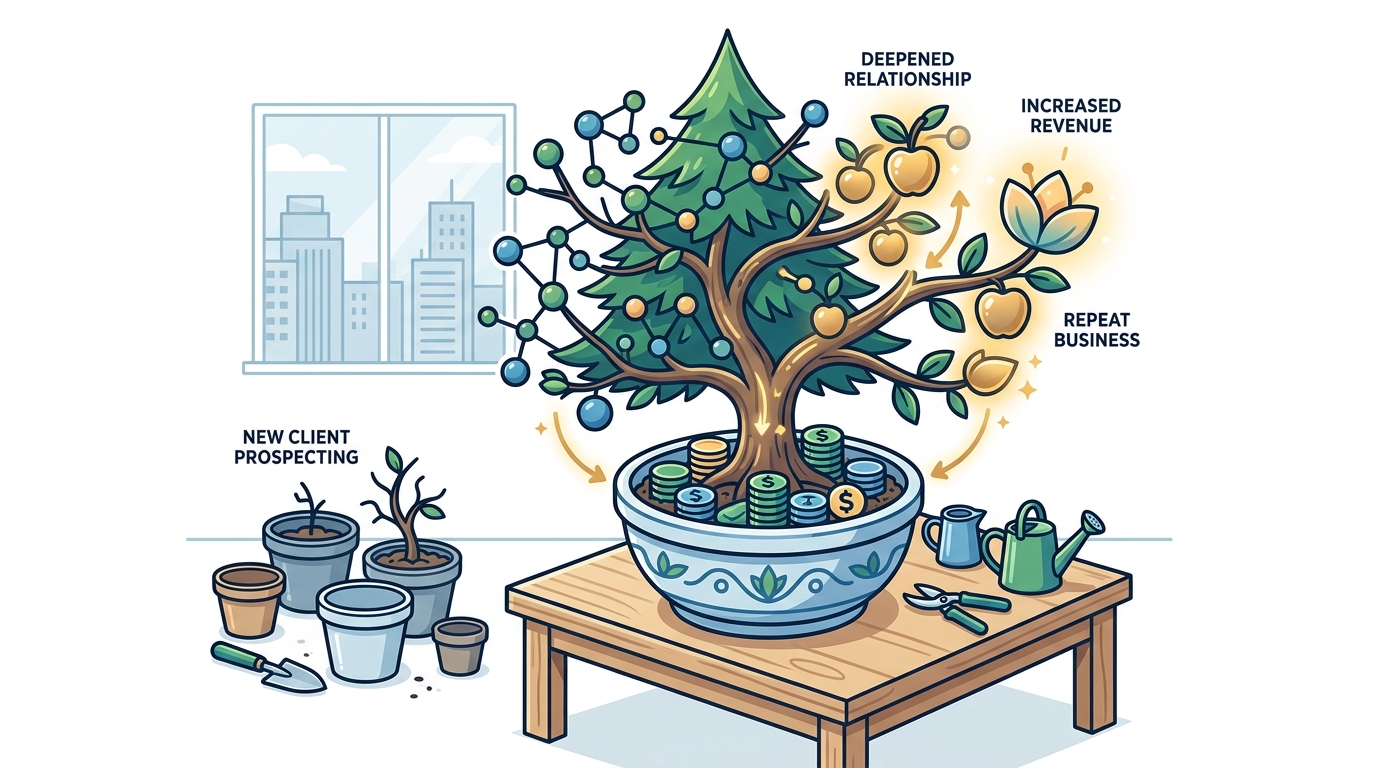
Growing clients is the single most reliable way for a marketing agency to increase revenue without the high cost of constant new-business prospecting. Research from Bain & Company confirms that acquiring a new customer is 5 to 25 times more expensive than retaining an existing one. Yet most agencies still pour the majority of their energy into chasing new logos instead of deepening relationships with the clients already on their roster. In this guide, we break down the proven strategies that help small to mid-sized agencies grow their existing client base, win smarter new business, and build lasting profitability.
Why Existing Clients Are Your Biggest Growth Lever
Agency Management Institute teaches that 60 to 70 percent of an agency's net new revenue every year should come from existing clients. For most shops, however, the actual number falls far short of that benchmark. The gap is not because clients lack budget; it is because agencies lack a structured approach to organic growth.
The economics are clear. According to Harvard Business Review research popularized by Bain & Company, a mere 5 percent increase in customer retention can boost profits by 25 to 95 percent. The probability of selling to an existing customer sits at roughly 60 to 70 percent, compared with just 5 to 20 percent for a brand-new prospect.
| Metric | New Client Acquisition | Existing Client Growth |
|---|---|---|
| Relative Cost | 5–25x higher | Baseline |
| Close Rate | 5–20% | 60–70% |
| Profit Impact (5% lift) | Variable | 25–95% profit increase |
| Revenue Share Target | 30–40% | 60–70% |
If you want to see how AMI agencies approach this challenge hands-on, explore the Growing the Clients You Already Have workshop.
Redefine the Account Team's Role
Client growth is a team sport, and your account executives are the front line. The problem? Many AEs do not see growing revenue as part of their job description. As Drew McLellan of AMI explains, account service teams often have no infrastructure, no measurement system, and no roadmap to grow the clients they already serve.
Shift the Mindset From Order-Taker to Business Advisor
A business advisor is an account executive who understands finance, distribution, and competitive dynamics well enough to solve business problems, not just execute marketing tactics. When AEs position themselves this way, your agency moves from vendor status to trusted partner. Learn more about how agency account managers build better client relationships.
Prepare Better Questions for Every Meeting
One of the simplest starting points is meeting preparation. Instead of just assembling an agenda and project updates, coach AEs to prepare three or four probing questions about the client's broader business. These questions demonstrate genuine curiosity and often surface new project opportunities.
Understand the Client's Internal Cadence
Know when your client reports to their leadership. If their update meeting is every Thursday at 2:00 PM, make sure your weekly status report lands by Wednesday evening. That kind of anticipation builds trust faster than any pitch deck. Discover what clients really want from the agencies they hire.
Build Authority Through Thought Leadership
Thought leadership is the practice of consistently sharing deep, niche expertise through content, speaking, and publishing to attract right-fit clients to your agency. Drew McLellan and Stephen Woessner outline this approach in their book Sell With Authority, which argues that agencies still competing on deliverables alone are stuck on a financial roller coaster.
Agencies that invest just 10 to 20 hours per month in content creation can become findable on search engines, attract speaking invitations, and position themselves as the go-to experts in a vertical. The key is narrowing your focus to a specific niche rather than writing generic content that any competitor could claim.
Install Systems and Processes for Growth
A system is a documented, repeatable workflow that allows your agency to deliver results without person dependency. Without systems, every team member operates in their own way, creating a ceiling on how much the agency can scale.
AMI recommends starting with what David Jenyns calls the Critical Client Flow: systemize the core way your business makes money first. Then layer in financial systems like monthly P&L reviews, followed by growth-oriented processes such as new-business pipelines and client satisfaction surveys. Agencies interested in building those financial muscles can explore AMI's key agency metrics framework.
Prospect Smarter With the Four Ts
When it is time to pursue new business, AMI's Drew McLellan recommends the Four Ts framework: Teach, Trust, Told Apart, and Timing.
- Teach: Educate prospects with insights they have not considered. Provocation-based selling shines a light on problems the client did not know they had.
- Trust: Deliver on small commitments before asking for large ones. Pick up project work and prove your value before pitching a retainer.
- Told Apart: Clarify what your agency stands for so prospects can distinguish you from every other shop.
- Timing: Respect the buying cycle. Rushing a prospect is the fastest way to lose them.
Agency growth typically comes from three equal sources: traditional prospecting, organic growth from existing clients, and leadership networking. Neglecting any one of these areas means leaving revenue on the table. Read more about business development strategies for agencies.
Track the Metrics That Actually Matter
AGI per FTE is a metric that divides your agency's adjusted gross income by the number of full-time equivalent employees. AMI data shows that member agencies average about $135,000 of AGI per FTE, while the broader industry often sits at $100,000 to $110,000. The target benchmark is $150,000. Agencies below $130,000 should treat the number as an early warning sign of thin margins.
Other critical metrics include client retention rate, average revenue per client, and quarterly growth goals for every employee. The most profitable AMI agencies share a common trait: their leaders still love to learn and set ambitious personal growth goals each quarter.
Key Takeaways
- Aim for 60 to 70 percent of net new revenue from existing clients each year.
- Retaining a client costs 5 to 25 times less than acquiring a new one.
- Train AEs to be business advisors, not order-takers.
- Invest in thought leadership content to attract right-fit prospects to your door.
- Systemize your Critical Client Flow before layering on growth processes.
- Use the Four Ts framework (Teach, Trust, Told Apart, Timing) for smarter prospecting.
- Track AGI per FTE and target $150,000 as your benchmark.
Frequently Asked Questions
What is the most cost-effective way to grow an agency?
Growing your existing client base is the most cost-effective path. Research shows the probability of selling to an existing customer is 60 to 70 percent, versus just 5 to 20 percent for new prospects.
How much revenue should come from existing clients?
AMI recommends that 60 to 70 percent of your net new revenue every year should come from clients you already serve.
What is AGI per FTE and why does it matter?
AGI per FTE is adjusted gross income divided by full-time equivalent employees. It reveals whether your agency is staffed efficiently. The target is $150,000; anything below $130,000 warrants concern.
How do I turn account executives into client growth drivers?
Give them a clear growth mandate, teach them to ask probing business questions, and build an internal system that measures and celebrates client revenue growth quarterly.
What is the Four Ts framework for agency new business?
The Four Ts stand for Teach, Trust, Told Apart, and Timing. It is a prospecting philosophy that emphasizes educating prospects, earning trust through delivery, differentiating your agency, and respecting buying cycles.
How does thought leadership help agencies win clients?
When an agency consistently publishes niche expertise, ideal prospects discover and pre-qualify themselves before ever making contact. This shortens the sales cycle and increases pricing power.
What systems should an agency implement first?
Start with the Critical Client Flow, the core process your business uses to deliver work and generate revenue. Then add financial reporting systems and growth accountability structures.
How can peer networks accelerate agency growth?
Peer networks give agency owners a confidential group of non-competing peers who share best practices, financial benchmarks, and accountability. AMI peer network members often cite it as the best business decision they have made.
Your Next Step
If you are ready to build a repeatable client growth engine for your agency, start by attending AMI's Growing the Clients You Already Have workshop. You will leave with a step-by-step blueprint, baked-in accountability, and the confidence to grow your book of business starting the week you return to the office.