

Growing clients is the single most important lever for sustainable agency revenue, yet most marketing agencies underinvest in it. Research shows that acquiring a new customer can cost up to five times more than retaining an existing one, and a mere 5% improvement in retention can boost profits by 25% to 95%. For small to mid-sized agencies, the path to higher AGI and profitability runs directly through the clients you already serve. This guide breaks down the most effective strategies for growing your client base, deepening existing relationships, and building the infrastructure your account team needs to drive results.
Why Existing Clients Are Your Best Growth Engine
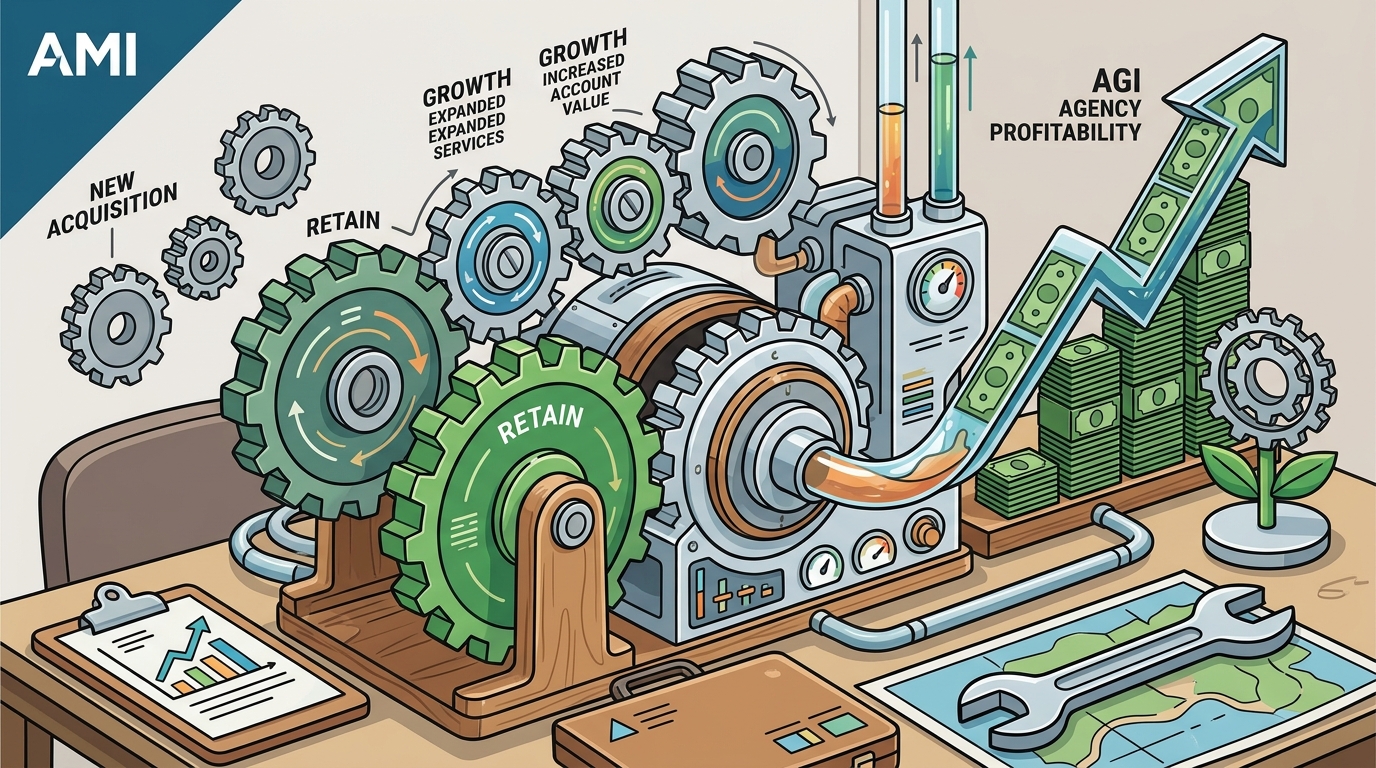
Client growth is the process of expanding revenue from the customers you already serve through deeper relationships, upselling, and cross-selling. According to AMI, 60-70% of your net new revenue every year should come from existing clients, but most agencies fall far short of that benchmark.
The math is clear. Customer acquisition costs have surged by 60% over the last five years, and companies have a 60-70% chance of selling to an existing customer versus only a 5-20% chance with a new prospect. When you invest in the clients already on your roster, you protect margins and create compounding revenue.
Redefining Your Account Team's Role in Growth
One of the biggest barriers to client growth is that account executives do not see sales as part of their job. As Drew McLellan of Agency Management Institute explains, many AEs say "this is their budget, and I'm not a salesperson." The reality is that growing clients is not about traditional selling. It is about asking smarter questions and understanding the client's business at a deeper level.
Prep With Purpose
Before every status meeting, your AEs should prepare 3 to 4 probing questions that go beyond project updates. These questions should explore what is happening in the client's broader business, their competitive landscape, and their internal challenges. Walking out of every meeting smarter than when you walked in is the goal.
Shift the Mindset
Growth is not an optional extra. Each account executive should carry a target to grow their book of business by at least 10% per year. When growth targets are explicit, they become achievable.
The Four Ts: Teach, Trust, Told Apart, Timing
AMI's framework for finding and growing the right clients centers on four pillars: Teach, Trust, Told Apart, and Timing.
Teach and Trust
Teaching your clients something new builds relationships and positions your agency as a strategic partner. Provocation-based selling is the practice of identifying problems the client did not know they had and presenting solutions. When you consistently deliver value, trust follows naturally, and trust is what separates your agency from every other vendor.
Told Apart and Timing
Differentiation is the ability to clearly articulate what your agency stands for and why that matters to a specific client. Timing means recognizing that relationships develop over months, not days. Agencies that follow these four strategies secure clients who are a perfect long-term fit.
Client Satisfaction as a Leading Indicator
You cannot grow a client who is unhappy. Regular client satisfaction surveys act as an early warning system and a conversation starter. AMI reports that agencies implementing a structured client growth process saw billings from existing clients grow by 17% and client satisfaction scores rise by an average of 23% within six months.
Client satisfaction data also gives your account team permission to have strategic conversations. When a client sees that you are invested in measuring and improving the relationship, they view you as a partner rather than a vendor.
Client Growth vs. New Business: A Cost Comparison
| Metric | Existing Client Growth | New Client Acquisition |
|---|---|---|
| Probability of closing a sale | 60-70% | 5-20% |
| Relative cost | 1x (baseline) | 5-25x more expensive |
| Profit impact of 5% improvement | 25-95% profit increase | Varies widely |
| Revenue target (AMI benchmark) | 60-70% of net new revenue | 30-40% of net new revenue |
| Average time to first revenue | Immediate (relationship exists) | 3-12 months pipeline |
Sources: Business Dasher, Artisan Strategies, AMI workshop data.
Building Growth Infrastructure and Accountability
Strategy without infrastructure is just wishful thinking. Agencies that succeed at client growth build systems around it.
Track AGI Per Client
Every AE should know exactly how much adjusted gross income (AGI) they manage and track whether it is growing or declining each quarter. AGI is the total revenue your agency retains after subtracting pass-through costs. If your team cannot say this number off the top of their head, that is where you start.
Report and Celebrate Wins
Client growth should be part of your regular new business reporting. When the agency celebrates a $20,000 expansion from an existing account the same way it celebrates a new logo, the culture shifts. AMI's growth, profit, and sanity workshop helps owners build these systems from the ground up.
Set Quarterly Growth Goals
AMI recommends that every employee set a quarterly growth goal across three dimensions: personal skill development, serving clients better, and contributing to the agency's growth. This creates a rhythm of continuous improvement across the entire team.
Thought Leadership and Authority Positioning
Clients want to work with agencies that are recognized experts. Thought leadership is the practice of consistently sharing original insights that position your agency as an authority in your niche. This can take the form of blog posts, podcasts, speaking engagements, or original research.
The AMI blog and the Build A Better Agency podcast are examples of content strategies that attract the right prospects and reinforce trust with existing clients. When your clients see you publishing insights that help their industry, they bring you into more strategic conversations and bigger budgets.
Retention-focused companies grow 2.5 times faster than those prioritizing acquisition alone, according to Artisan Strategies research. That growth advantage compounds when paired with a visible thought leadership presence.
Key Takeaways
- 60-70% of your annual net new revenue should come from growing existing clients, not chasing new logos.
- Acquiring new clients costs 5 to 25 times more than retaining and expanding current ones.
- Account executives must own growth targets and prepare strategic questions for every client meeting.
- The Four Ts framework (Teach, Trust, Told Apart, Timing) provides a repeatable system for deepening client relationships.
- Tracking AGI per client and reporting growth alongside new business wins shifts agency culture toward retention.
- Client satisfaction surveys are a leading indicator of growth potential and should be conducted regularly.
- Thought leadership content strengthens existing relationships and attracts better-fit prospects simultaneously.
Frequently Asked Questions
What is the most cost-effective way to grow an agency?
Growing your existing clients is the most cost-effective path. The probability of selling to an existing client is 60-70%, compared to just 5-20% for a new prospect, and the cost is a fraction of acquisition spend.
How much revenue should come from existing clients?
AMI recommends that 60-70% of your net new revenue each year come from existing clients. Most agencies fall well below this target because they lack a formal growth process.
What are the Four Ts in agency client development?
The Four Ts are Teach, Trust, Told Apart, and Timing. They represent a framework for building deep client relationships by sharing knowledge, earning confidence, differentiating your agency, and respecting the pace of relationship development.
How do I get my account team to sell without feeling salesy?
Reframe selling as strategic curiosity. Train AEs to ask 3-4 probing questions at every meeting about the client's broader business challenges. When growth comes from understanding rather than pitching, it never feels like a hard sell.
What is AGI, and why does it matter for client growth?
AGI stands for adjusted gross income. It is the revenue your agency keeps after subtracting pass-through expenses like media buys and printing. Tracking AGI per client lets your team measure real growth rather than top-line vanity metrics.
How often should we survey client satisfaction?
At minimum, conduct a formal client satisfaction survey annually. Many high-performing agencies run shorter pulse checks quarterly to catch issues early and uncover expansion opportunities.
Does thought leadership really help grow existing clients?
Yes. When clients see your agency publishing original research, speaking at industry events, or hosting a podcast, they gain confidence in your strategic capabilities and are more likely to bring you larger, higher-margin projects.
Where can I learn more about growing agency clients?
AMI's Growing the Clients You Already Have workshop is a two-day program designed specifically for account teams and agency owners who want a step-by-step process for expanding existing accounts.
Start Growing Your Clients Today
If your agency is ready to stop leaving revenue on the table, the next step is building a structured client growth process. Register for AMI's Growing the Clients You Already Have workshop and walk away with a blueprint your entire account team can implement immediately.