

Five Cultural Shifts That Turn Agency Account Executives Into Strategic Client Leaders
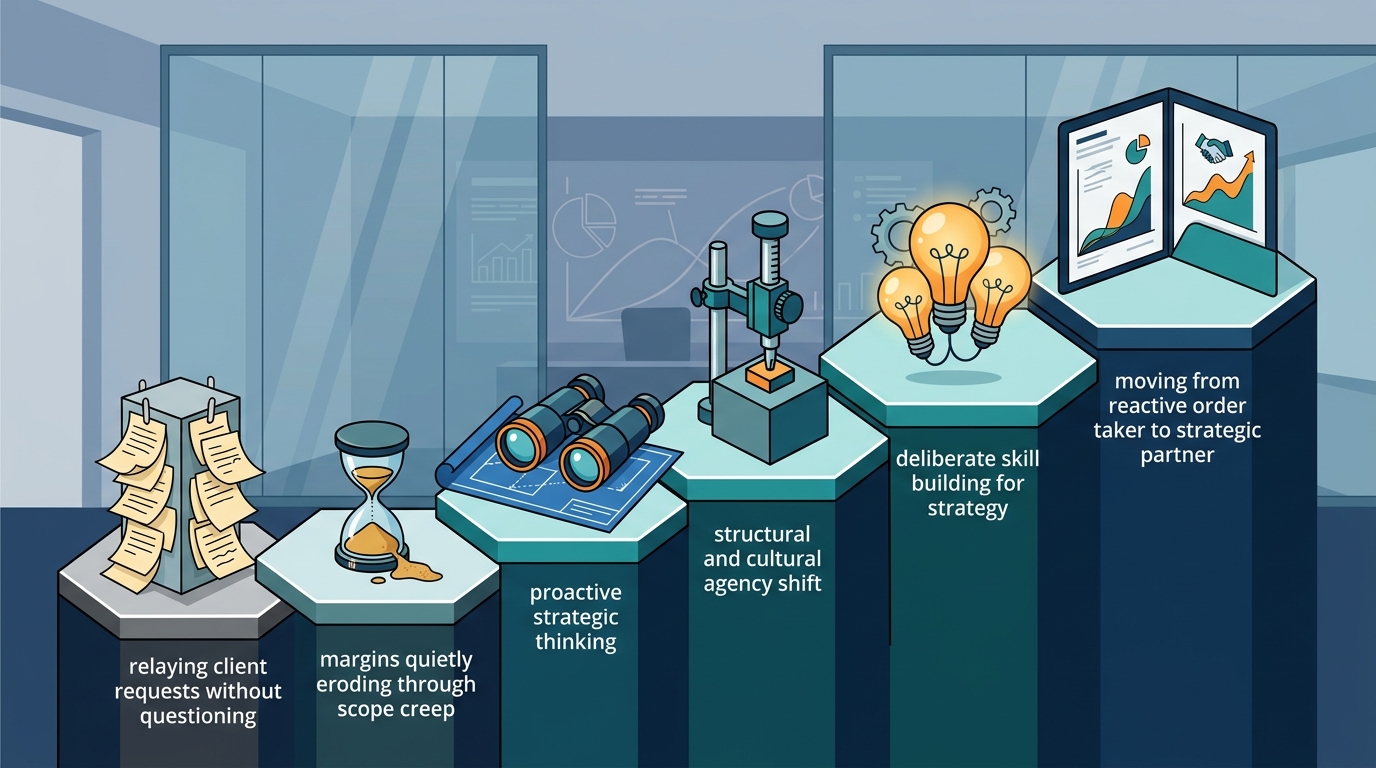
Most agency owners know the symptoms: account executives relay client requests without questioning them, margins quietly erode through scope creep, and organic growth stalls because nobody is proactively pitching ideas. The real fix is not another skills workshop bolted onto business-as-usual—it is a deliberate cultural shift inside the agency itself.
Below are five interlocking changes that move AEs from reactive order takers to the strategic partners your clients actually want.
Shift 1 — Rewrite the Scoreboard: Measure What Strategic Partners Do
If account executives are evaluated solely on on-time delivery and client satisfaction scores, they will optimize for compliance, not growth. Strategic behavior follows strategic metrics.
New Metrics to Track
- Organic account growth rate. AMI's AE Bootcamp teaches AEs to target a minimum 10 percent growth from existing clients by identifying opportunities and pitching new ideas rather than passively servicing requests.
- AGI per account. Tracking Adjusted Gross Income per client—not just top-line billings—exposes where time is being given away for free.
- Proactive recommendations delivered. Count the unsolicited strategic ideas each AE brings to clients per quarter. The act of tracking it legitimizes the behavior.
- Scope-change capture rate. How many out-of-scope requests were converted to paid change orders versus silently absorbed?
When the scoreboard rewards strategic actions, AEs stop waiting for instructions and start looking for opportunities.
Shift 2 — Make Business Literacy Non-Negotiable
An AE cannot advise a client on business outcomes if they do not understand their own agency's financial model. Yet many agencies treat financial education as a leadership-only conversation.
Practical Steps
- Teach agency math early. Every AE should understand AGI, cost of goods sold, and the ideal 55/25/20 overhead model. AMI's training illustrates that a single $5,000 write-off can require $89,000 in new billings to replace—a sobering number that changes behavior fast.
- Share real P&L snapshots. Open the books on a per-project or per-client basis so AEs see the direct connection between their time management and margin.
- Require client-side business fluency. Before any strategy meeting, AEs should review the client's most recent earnings call, annual report, or industry benchmarks. The goal is to speak the client's language, not the agency's.
When AEs understand both sides of the balance sheet, scoping conversations shift from "how many hours?" to "what business result justifies this investment?"
Shift 3 — Build a Discovery-First Client Cadence
Order-taking thrives when every client interaction begins with a task list. Strategic partnerships start with discovery.
What Discovery-First Looks Like in Practice
- Quarterly business reviews (QBRs). Replace status-update meetings with structured QBRs where the AE presents competitive insights, performance data, and forward-looking recommendations before asking about upcoming projects.
- The "What do you need?" reframe. There is a powerful distinction between asking a client "What do you want?" versus "What do you need?" The order taker focuses on project scope, schedule, and budget, while the trusted advisor focuses on how the project delivers business results.
- Annual planning facilitation. AEs should prepare an annual marketing plan for each client—complete with SMART goals—rather than waiting for the client to hand them a brief each quarter.
Discovery is not an event; it is a rhythm. Embedding it into recurring cadences makes strategic thinking habitual rather than heroic.
Shift 4 — Create a Proactive Idea Pipeline
Clients consistently say they want agencies to bring them unsolicited ideas. Yet most AEs are so buried in execution that proactive thinking becomes the first thing dropped from the calendar.
System, Not Willpower
- Block "think time" on the calendar. Protect a recurring two-hour block each week for industry scanning, competitive analysis, and idea development. Tools like the Eisenhower Matrix and time blocking—staples of effective AE time management—keep this protected.
- Run monthly idea sprints. Pair AEs with a strategist or creative lead for a 90-minute sprint focused on one client. Output: one or two unsolicited concepts ready to present.
- Maintain an opportunity log per account. Keep a running document of upsell and cross-sell ideas with estimated revenue impact. Review it monthly with agency leadership.
A 2024 DBA survey of 675 clients found that nearly half felt their agency relationship was too transactional. A steady stream of proactive ideas is the fastest antidote to that perception.
Shift 5 — Install Coaching Loops, Not One-Off Training
Workshops deliver motivation. Coaching delivers transformation. The difference is what happens in the weeks after the classroom session ends.
Why Training Alone Fails
A common pattern in agencies: the team returns from training motivated, tries a few things, and within weeks it is back to business as usual. Account growth is not just a skills problem—it is a structural one. Sustainable change requires reinforcing skills, behaviors, and systems together.
Building the Loop
- Weekly 1-on-1 coaching check-ins. A 15-minute conversation between the AE and their manager reviewing one live client situation through a strategic lens.
- Role-play tough conversations. Practice pricing discussions, scope pushback, and upsell pitches in a low-risk environment before doing them live.
- Post-workshop action plans. After any training event, each AE should leave with a written action plan shared with leadership to create accountability.
- Peer learning pods. Groups of three to four AEs meeting biweekly to share wins, workshop challenges, and hold each other accountable.
Agency leaders need to have the right processes, resources, and support in place to help account managers position themselves as trusted advisors. Without that structural support, even the best-trained AE will drift back to order-taking under the pressure of daily deadlines.
Key Takeaways
- Metrics drive behavior. If your scoreboard rewards task completion, you will get order takers. Measure organic growth, AGI, and proactive recommendations instead.
- Financial literacy is foundational. AEs who understand agency math protect margins and price with confidence.
- Discovery must be a cadence, not an event. QBRs, annual plans, and outcome-focused questions keep every client conversation strategic.
- Proactive ideas require systems. Think time, idea sprints, and opportunity logs turn good intentions into a repeatable pipeline.
- Coaching outlasts training. Sustainable change needs weekly reinforcement, role-play, action plans, and peer accountability—not a one-time seminar.
Frequently Asked Questions
How long does it take to see results from strategic AE training?
Most agencies see measurable behavior change—better scoping, fewer write-offs, higher proactive outreach—within 60 to 90 days, provided the training is paired with ongoing coaching and revised performance metrics. Cultural transformation across the full team typically takes six to twelve months of consistent reinforcement.
What is the difference between an order taker and a strategic partner in an agency?
An order-taker AE asks "What do you want?" and focuses on scope, schedule, and budget. A strategic partner asks "What do you need?" and focuses on how the project delivers business results. The shift is from a transactional, tactical posture to a strategic, relational one that links agency work to client outcomes.
Do small agencies with fewer than 20 people really need formal AE training?
Yes—arguably more so. In a small agency, every AE interaction carries outsized impact on retention and growth. Even lightweight structures like weekly coaching check-ins and monthly idea sprints can transform performance without requiring a large training budget.
What financial concepts should every agency AE understand?
At a minimum: Adjusted Gross Income (AGI), cost of goods sold, overhead ratios (the 55/25/20 model), multiplier-based estimating (1.3×–1.5×), and the revenue impact of write-offs. Understanding these concepts allows AEs to price, scope, and negotiate confidently.
How can agency owners prevent AEs from reverting to order-taking after training?
The most effective approach combines structural changes—revised KPIs, recurring coaching cadences, and peer accountability pods—with leadership modeling. When agency owners consistently ask "What strategic recommendation are you bringing to the client?" in internal meetings, it signals that strategic thinking is an expectation, not an optional extra.